Key takeaways
- Compare the best pry bars for demolition, trim removal and nail pulling, from a compact cat's paw puller to a 30 inch wrecking bar for heavy work.
- Top Pick: Vaughan SuperBar B215, 15 Inch Flat Pry Bar
- Runner-up: Estwing Pro-Claw RSC, 16 Inch Roofing and Siding Bar
- Also consider: TEKTON Angled End Handled Pry Bar Set, 3-Piece (LSQ42103)
The best all-around pry bar for most home and jobsite work is a 15 inch flat bar such as the Vaughan SuperBar B215, which pairs a rocker head with three beveled nail slots for trim removal, flooring work and light demolition. For heavier tear-out, a long utility bar such as the 30 inch Stanley FatMax Xtreme FuBar III delivers far more leverage, while handled sets from TEKTON suit automotive and machinery work, the Estwing Pro-Claw RSC is shaped for roofing and siding, and the compact Spec Ops cat’s paw handles embedded nails in tight spaces.
As an Amazon Associate, we earn from qualifying purchases.
Table of Contents
- How to Choose a Pry Bar
- The 5 Best Pry Bars
- Pry Bar Length Guide
- Care and Safety Notes
- Frequently Asked Questions
- Conclusion
- Product and ASIN Reference
How to Choose a Pry Bar
Pry bars fall into a few distinct families, and each suits a different kind of work. A flat bar is a thin, wide piece of spring steel with a claw at one end and a flat, beveled blade at the other. The thin blade slips under baseboards, casing and flooring with less damage to the surrounding surface, which makes flat bars the default for remodeling work where materials need to survive removal. A cat’s paw is a shorter bar with a curved, spoon-shaped claw built to dig out nail heads that sit flush with or below the wood surface. A wrecking bar is a longer round or hex bar with a gooseneck claw, made for framing tear-out and heavy lifting where leverage matters more than finesse. Handled pry bars, common in automotive work, use a shaft and grip much like a screwdriver. Utility bars such as the FuBar line combine a pry claw, a board-grabbing jaw and a striking face in one forged tool.
Length controls leverage. Bars under 12 inches fit in a tool pouch and handle trim and nail pulling in tight quarters. The 15 to 18 inch range is the general-purpose zone for flooring, decking and light demolition. Bars of 24 inches and longer multiply force for prying apart framing and stripping roofs, but they are clumsy for detail work and can split the piece you wanted to save.
Steel and heat treatment decide how a bar ages. Forged, spring-tempered steel flexes slightly under load and springs back, while cheaper stamped bars can bend and stay bent. Look for beveled nail slots, since a beveled slot grips the nail shank and rolls the nail out instead of slipping off the head. If you plan to strike the bar with a hammer, choose a model with a tempered striking face or steel cap.
The 5 Best Pry Bars
1. Vaughan SuperBar B215, 15 Inch Flat Pry Bar

The Vaughan SuperBar is the classic American flat bar, forged from spring-tempered steel and made in the USA. Its defining feature is the Shepherd’s Crook rocker head, a deep curve at the claw end that acts as a rolling fulcrum. As you push the handle down, the head rolls and lifts the nail in a smooth arc, giving the 15 inch bar pulling power that feels closer to a longer tool. Three beveled nail slots are spread across both ends, so there is nearly always a slot at a workable angle, and the polished blades are ground thin for sliding under molding and flooring without chewing up the wall behind them.
This mid-range bar suits remodelers, floor installers and homeowners who want one flat bar for trim salvage, prying up nailed boards and scraping duties. The flat profile rides in a tool belt, and the spring temper means the blade can flex under a heavy pull and return to true. It is not a demolition bar for framing tear-out, and there is no striking cap, so heavy hammer work belongs to a heavier tool. For nail pulling and controlled prying, the SuperBar remains the benchmark in its class.
Specs
- Model: B215 (VN45001)
- Length: 15 in (381 mm)
- Material: Forged, spring-tempered steel
- Nail slots: 3 beveled slots
- Head design: Shepherd’s Crook rocker head
- Blade finish: Polished, ground sharp
- Origin: Made in the USA
2. Estwing Pro-Claw RSC, 16 Inch Roofing and Siding Bar

The Estwing Pro-Claw RSC is a patented 3-in-1 bar built for roofing, siding and construction work, forged in the USA from fine American tool steel. One end carries a wide, flat pry blade with 2.5 inches of lift, shaped to slide under shingles and siding courses and catch the wide heads of roofing nails. The other end carries a claw sized for pulling nails left behind in the deck during tear-off. The flat profile lets the bar work under a shingle tab and lift a nail without tearing the course above it, the motion needed to swap a damaged shingle or replace flashing around vents and chimneys.
This is a premium, single-purpose-leaning bar. Roofers and siding crews get the most from the RSC, and it also serves anyone who pries wide, thin materials such as paneling and deck boards. The claw measures 85 mm long and 22 mm wide, dimensions published by Estwing for controlled, high-leverage pulls. Because the blade is wide and thin, the RSC is less suited to heavy framing demolition than a gooseneck wrecking bar. Within its niche, the forged one-piece build and generous blade make it a durable specialist.
Specs
- Model: RSC
- Length: 16 in (406 mm)
- Material: Forged American tool steel
- Pry blade lift: 2.5 in (63.5 mm)
- Claw length: 85 mm
- Claw width: 22 mm
- Design: 3-in-1 roofing, siding and construction bar
- UPC: 034139104414
- Origin: Made in the USA
3. TEKTON Angled End Handled Pry Bar Set, 3-Piece (LSQ42103)

TEKTON takes a different approach with this handled set, which covers 12, 17 and 25 inch sizes in one kit. Each bar pairs a chrome vanadium steel shaft with a molded polypropylene handle, and the tip is angled so the bar can lever under boards, panels and components while your hand stays clear of the work surface. The angled geometry works like a built-in fulcrum: press down on the handle and the tip lifts, which suits prying apart crates and pallets, separating nailed boards, and reaching covers in engine bays where a flat bar cannot get a grip.
The set sits in the mid-range tier and suits anyone who mixes shop, automotive and household prying. Owning three lengths means the short bar handles delicate trim while the 25 inch bar takes on stubborn boards, and the handles add comfort during long sessions. TEKTON backs the set with a warranty described as having no time limits and no receipt requirement, published in the listing data. Handled bars are not made for hammer strikes or heavy framing demolition, so pair this set with a wrecking bar if tear-out work is on the list.
Specs
- Model: LSQ42103
- Pieces: 3
- Sizes: 12 in, 17 in, 25 in
- Shaft material: Chrome vanadium steel
- Handle material: Polypropylene
- Tip style: Angled end
- UPC: 020209421031
- Warranty: No time limits, no receipts, per TEKTON listing data
4. Spec Ops Tools 10 Inch Nail Puller Cat’s Paw (SPEC-D10CLAW)
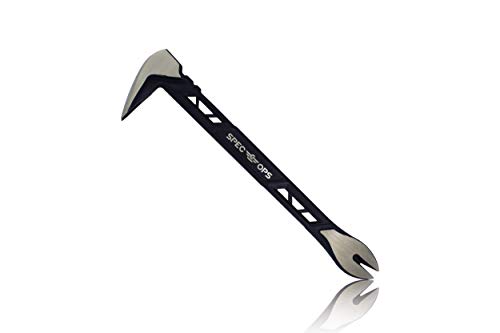
The Spec Ops cat’s paw is a compact 10 inch puller built from high-carbon steel for the nails that flat bars struggle with: headless, embedded and flush-driven fasteners. Both ends carry claw pullers with teardrop nail slots, and the curved head geometry concentrates force so the claw can bite beside a buried nail head and roll it out with limited damage to the surrounding wood. At 10 inches the bar rides in a tool pouch and reaches into corners and under cabinets where a 15 inch bar will not fit. Precision-honed edges help the claw slip into tight seams for light prying as well.
This is the budget pick of the group and a natural companion to a full-size flat bar rather than a replacement for one. Carpenters, deck builders and remodelers who pull nails all day will appreciate the dual strike zones and the limited lifetime warranty published by Spec Ops, which also donates three percent of proceeds to veteran causes, a detail printed on the listing. Short bars deliver modest leverage, so framing nails in dense lumber will still call for a longer bar. For finish work and rescue pulls on broken or headless nails, this small claw earns its pouch space.
Specs
- Model: SPEC-D10CLAW
- Length: 10 in
- Material: High-carbon steel
- Product dimensions: 10.75 x 3.2 x 0.75 in
- Head style: Claw, dual nail pullers with teardrop slots
- Warranty: Limited lifetime warranty
- UPC: 810005200240
5. Stanley FatMax Xtreme FuBar III, 30 Inch Utility Bar (55-120)

The FuBar III is Stanley’s heavy utility bar, a one-piece forging of carbon steel that combines several demolition tools in a single 30 inch frame. A serrated gripping jaw grabs standard lumber sizes so boards can be twisted, bent back into line or torn free, and a beveled nail slot handles pulling and prying. The tempered striking face is built to be hit and to hit with, letting the FuBar work as a light sledge for driving stakes and splitting nailed joints apart. A textured grip runs along the bar for control, and the head spans 6-3/4 inches wide with a 2 inch claw blade.
At 8.51 pounds, this is a premium, heavy-duty tool for demolition crews, deck builders and anyone gutting a structure. The 30 inch length multiplies force far beyond a flat bar, so nailed sill plates, subfloor sheets and framed partitions come apart quickly. That same force makes the FuBar III a poor choice for salvage work, since trim and flooring rarely survive it, and the weight tires arms during overhead work. Used where destruction is the goal, it replaces a wrecking bar, a small sledge and a board wrench in one tool.
Specs
- Model: 55-120
- Length: 30 in (762 mm)
- Weight: 8.51 lb (3.86 kg)
- Construction: One-piece forged carbon steel
- Claw blade width: 2 in (51 mm)
- Head width: 6-3/4 in (171 mm)
- Striking face: 2 x 1-5/8 in, tempered
- Features: Serrated board-grabbing jaw, beveled nail slot, textured grip
Pry Bar Length Guide
| Bar length | Typical styles | Jobs it suits |
|---|---|---|
| 7 to 10 in | Cat’s paw, mini flat bar | Embedded nails, trim, pouch carry |
| 12 to 15 in | Flat bar, handled bar | Baseboards, flooring, general pulling |
| 16 to 18 in | Roofing bar, flat bar | Shingles, siding, deck boards |
| 21 to 25 in | Handled bar, wrecking bar | Pallets, stubborn boards, machinery |
| 30 in and up | Utility bar, wrecking bar | Framing tear-out, demolition, lifting |
Care and Safety Notes
Keep blade edges clean and lightly oiled so rust does not dull the thin ground edge that makes a flat bar useful. Check nail slots for spreading or cracks, since an opened slot will slip off nail heads under load. Store bars dry, away from the bottom of a toolbox where edges get nicked.
Wear eye protection whenever you pull nails or strike a bar, because a nail under tension can pop free at speed. Pry with steady pressure rather than jerking, keep your free hand out of the line of the claw, and use a wood block under the bar as a fulcrum pad when the surface needs protection. Never extend a bar with a pipe for extra leverage; the added force can snap the shaft or spring the piece loose without warning.
Frequently Asked Questions
What size pry bar is best for removing trim and baseboards?
A flat bar in the 12 to 15 inch range is the best fit, since the thin blade slides behind trim without crushing it and the length gives enough leverage to ease nails out gradually. The Vaughan SuperBar B215 at 15 inches is built for this work, and a short cat’s paw helps with nails that snap or sit below the surface.
What is the difference between a flat bar and a wrecking bar?
A flat bar is a thin, wide piece of spring steel with a claw and a flat blade, made for controlled prying, trim salvage and nail pulling. A wrecking bar is a thicker round or hex bar with a gooseneck claw, made for heavy demolition and lifting where leverage matters most and surface damage is acceptable.
Can a pry bar pull headless or embedded nails?
Yes, a cat’s paw is designed for that job. Its curved claw is driven beside the buried nail so the slot can grip the shank below the surface, then the rounded head rolls the nail out. The Spec Ops 10 inch puller follows this pattern, trading some leverage for access.
How do I keep a pry bar from damaging the surface under it?
Place a wide wood block or a putty knife under the bar where it bears on the surface, which spreads the load and raises the fulcrum for a smoother pull. Work along the piece gradually, prying a small amount near each nail instead of forcing one spot, and keep the blade flat against the material.
Conclusion
Most buyers should begin with a 15 inch flat bar, and the Vaughan SuperBar B215 remains the reference design for trim work, flooring and everyday nail pulling. Add the Spec Ops cat’s paw when embedded and headless nails are common, choose the Estwing Pro-Claw RSC for roofing and siding, and reach for the TEKTON handled set when shop work calls for gripped leverage in several lengths. When the job is full demolition, the 30 inch Stanley FuBar III brings force that smaller bars cannot. Match the bar to the work, favor forged and tempered steel, and two or three bars will cover every prying job in the home and on the site.