Key takeaways
- Compare five proven wood glues for furniture and cabinet work, from waterproof Type I PVA to reversible liquid hide glue, and learn how to choose well.
- Top Pick: Titebond III Ultimate Wood Glue, 16 oz
- Runner-up: Titebond II Premium Wood Glue, 16 oz
- Also consider: Titebond Original Wood Glue, 8 oz
A strong glue joint starts with picking the right adhesive for the conditions the finished piece will live in. A kitchen cabinet door may face steam and splashes, a dining table needs a bond that sands cleanly, and an antique chair repair may need a joint a restorer can open again.
This guide compares five well-established wood glues: four PVA-family glues of different grades, from a waterproof Type I formula down to a classic interior-only glue, plus a ready-to-use liquid hide glue.
As an Amazon Associate, we earn from qualifying purchases.
Quick answer
For most furniture and cabinet work, a Type II water-resistant PVA handles everyday indoor projects that see occasional moisture, while a Type I waterproof PVA suits pieces exposed to regular water. Pick the classic interior PVA for dry indoor joinery on a budget, and choose liquid hide glue when you want a long assembly time or joints that can be reversed later.
Titebond III Ultimate Wood Glue, 16 oz

Titebond III is the highest-grade PVA in this guide and the default choice when a project will see real moisture. Its listing describes it as a polyvinyl acetate (PVA) glue that passes the ANSI/HPVA Type I water-resistance specification and is described by the maker as waterproof, suitable for interior and exterior use. That covers kitchen cabinets, bathroom vanities, and outdoor furniture; the listing also states approval for indirect food contact, suiting cutting boards and serving pieces.
| Brand | Product | ASIN | Key specs |
|---|---|---|---|
| Titebond | Titebond III Ultimate Wood Glue, 16 oz | B0002YQ3KA | PVA glue; ANSI/HPVA Type I waterproof; extended working time of 8 to 10 minutes; minimum use temperature 47 degrees F; approved for indirect food contact |
The maker’s comparison information on the listing gives it an extended working time of 8 to 10 minutes, which helps when a cabinet carcass or tabletop glue-up has many parts to align before the clamps go on. It has a strong initial tack, is non-toxic and solvent free, cleans up with water while wet, and sands easily without softening.
Respect its limits: never use it below 47 degrees F, and not for continuous submersion, below the waterline, or structural applications. The 16 oz bottle is model 1414.
Titebond II Premium Wood Glue, 16 oz

Titebond II is the step down in water resistance that most indoor furniture projects actually need. The listing describes it as the first PVA wood glue to pass the ANSI/HPVA Type II water-resistance specification, rated for interior and exterior work where exposure is occasional. It is also stated on the listing as FDA-approved for indirect food contact, so it suits items like serving boards that are washed rather than soaked.
| Brand | Product | ASIN | Key specs |
|---|---|---|---|
| Titebond | Titebond II Premium Wood Glue, 16 oz | B0000223UR | PVA glue; ANSI/HPVA Type II water resistant; honey cream color; full cure in 24 hours; minimum use temperature 55 degrees F |
The listing emphasizes strong initial tack, a fast speed of set, a short clamp time, and a 24-hour full cure. That makes it a good everyday glue for cabinet face frames, drawers, chairs, and interior doors. It cleans up with water or a wet cloth, sands well, and is non-toxic and solvent free. The dried glue is a honey cream color that blends with many light and mid-tone woods.
Note the conditions: do not use it below 55 degrees F, or for continuous submersion, below-the-waterline use, or structural joints. The listing states a shelf life of 12 months, so date the bottle when you open it.
Titebond Original Wood Glue, 8 oz

Titebond Original is the classic yellow wood glue that has long been the industry standard for interior woodworking, and Amazon lists it among the PVA-family interior glues. Its role is simple: the economical, proven choice for indoor joints that stay dry, such as bookcases, cabinet boxes, picture frames, and drawer boxes.
| Brand | Product | ASIN | Key specs |
|---|---|---|---|
| Titebond | Titebond Original Wood Glue, 8 oz | B0002YWZPW | 8 fluid ounces (237 milliliters); not water resistant, interior use only; full cure in 24 hours; yellow liquid in a bottle |
The listing states a full cure time of 24 hours and a viscosity of 3,200 cps. The 8 oz bottle (model 5063) suits occasional users better than a large bottle that may sit open for years.
The one rule that matters most: the listing rates its water resistance level as not water resistant. Do not use it for outdoor furniture, or kitchen and bathroom pieces that see regular splashing. Within dry interior work, it remains a dependable, inexpensive staple.
Gorilla Wood Glue, 8 oz
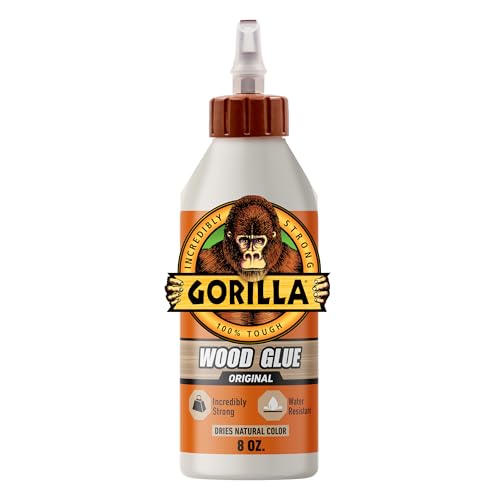
Gorilla Wood Glue is a water-based, cross-linking PVA that passes the ANSI/HPVA Type II water-resistance specification, putting it in Titebond II’s class: water resistant rather than waterproof, for indoor and outdoor projects. It works on hardwoods, softwoods, and natural wood composites.
| Brand | Product | ASIN | Key specs |
|---|---|---|---|
| Gorilla | Gorilla Wood Glue, 8 oz | B001E4E3KY | Cross-linking PVA glue; ANSI/HPVA Type II water resistant; clamp time of 20 to 30 minutes; fully cured in 24 hours; dries a natural tan color |
Its clearest advantage is the stated clamp time: the listing says it requires only 20 to 30 minutes of clamp time and is fully cured in 24 hours, which keeps a project moving when clamps are in short supply. It dries a natural, translucent tan color for a natural-looking bond line, produces no foaming, and is paintable and sandable once cured.
Cleanup follows the maker’s directions: wipe glue off while wet, shave or sand it once hardened, and wash hands with warm soap and water. The 8 oz bottle is model 620001, at 236.6 milliliters. Do not upgrade its rating in your planning: it is water resistant, not a Type I waterproof glue.
Titebond Liquid Hide Glue, 8 oz

Titebond Liquid Hide Glue is the non-PVA option in this guide and the pick for traditional furniture work, antique restoration, and musical instrument repair. Traditional hide glue must be mixed and heated, but this liquid, ready-to-use form requires no mixing, heating, or stirring.
| Brand | Product | ASIN | Key specs |
|---|---|---|---|
| Titebond | Titebond Liquid Hide Glue, 8 oz | B0002YXE7K | Liquid hide glue, ready to use; open assembly time of 10 minutes; total assembly time of 20 to 30 minutes; application temperature above 50 degrees F; not water resistant |
The listing’s guidelines state an open assembly time of 10 minutes and a total assembly time of 20 to 30 minutes, at 70 degrees F and fifty percent relative humidity. That long working time suits complex glue-ups, veneer work, and marquetry. The listing also credits it with exceptional strength, excellent sandability, and superior creep-resistance, notes it is unaffected by finishes, and mentions a crackling effect used for a weathered look in craft work.
Its defining trade-off is moisture sensitivity: rated not water resistant, and that same sensitivity lets parts be disassembled later, which restorers value. It is not intended for exterior use or anywhere moisture is likely, and not for structural or load-bearing applications. Clean up with a damp cloth while wet; scrape and sand dried excess. The listing states a 12-month shelf life, and the glue should be kept from freezing. The bottle is 8 fluid ounces (237 milliliters, model 5013).
How to Choose
Start with water exposure, because that decides the grade. Type I is the most demanding ANSI/HPVA water-resistance specification and is the one described as waterproof; Type II is water resistant and suits occasional moisture; and some glues are simply not water resistant and belong indoors only. Match the rating to the wettest conditions the piece will realistically face.
Next, consider working time. A complex cabinet glue-up argues for a longer stated working or assembly time, such as the Type I pick or the liquid hide glue. Simple joints are better served by a quick-grabbing interior or Type II glue.
Then think about the future of the joint. If the piece may need repair decades from now, as with antiques and instruments, a reversible hide glue joint is a genuine advantage. If the joint should be permanent and the piece will see moisture, a Type I or Type II PVA is the better tool.
Finally, check the conditions: minimum use temperatures differ, two picks are stated as approved for indirect food contact, shelf life is finite, and none of the five is a structural adhesive. For load-bearing joints, sound joinery and mechanical fasteners do the work; glue is a partner, not the whole structure.
Who should skip
Skip this category if your joint needs gap filling, structural strength on its own, or a bond across poorly fitting parts; these are furniture glues, not construction adhesives. Skip them for continuous submersion or below-the-waterline repairs, where a marine product is required.
Skip the interior-only and hide glue picks if the piece will live outdoors or get wet regularly, and skip the hide glue if you cannot keep the work above its stated application temperature. Skip larger bottles if you glue only occasionally: with stated shelf lives around 12 months on some listings, a smaller fresh bottle beats a large stale one.
FAQ
What is the difference between Type I and Type II wood glue?
Both are ANSI/HPVA water-resistance grades. Type I is the stricter specification, described as waterproof, and suits regular water exposure short of continuous submersion. Type II is water resistant, covering occasional moisture such as kitchen splashes. Below those sit glues rated not water resistant, for interior use only.
Which of these glues can I use on a cutting board?
Look for a listing statement about indirect food contact. Here, the Type I pick states it is approved for indirect food contact, and the Type II Titebond pick states it is FDA-approved for indirect food contact. Let the glue cure fully as directed before use; a cutting board is washed, not soaked, which suits these ratings.
Can a glued joint be taken apart later?
With the liquid hide glue, yes; that is one of its purposes. Its sensitivity to moisture allows parts to be disassembled, which is why restorers use it on antiques and instruments. Cured PVA joints are meant to be permanent, and forcing them apart usually damages the wood. If future repairability matters, choose the hide glue from the start.
How long do I need to leave the clamps on?
Follow the figure on your bottle, because the listings differ. The Gorilla pick states a clamp time of 20 to 30 minutes and a full cure in 24 hours; Titebond II describes a short clamp time with a 24-hour full cure. Where no number is given, keep the joint clamped until firmly set and do not stress it for a full day.
Final Verdict
For one bottle covering the widest range of work, the Type I waterproof PVA is the safest all-round choice, especially where moisture is part of the picture. The two Type II glues are the practical everyday options for indoor furniture with occasional moisture exposure. The classic interior glue remains the economical staple for dry indoor joinery, and the liquid hide glue stands alone for traditional work and long assembly times. Buy the grade your project actually needs, and respect each bottle’s temperature and moisture limits.