Key takeaways
- Compare five benchtop oscillating spindle sanders by drum size, stroke, table tilt and dust port, with guidance on choosing the right fit for wood curves.
Inside curves are where projects slow down. A bandsaw or jigsaw leaves a curved edge that still needs smoothing, and hand-sanding a tight radius is slow, uneven work. An oscillating spindle sander solves that problem: a rotating drum covered with a sanding sleeve also moves up and down as it spins, so the abrasive wears evenly and the edge comes out smooth, without grooves worn into one band.
Choosing one well comes down to a few decisions: match the drum diameters to the tightest curves in your work, decide whether you want a tilting table for bevelled edges, and plan for dust control. The five benchtop models below cover dedicated spindle sanders and two belt-and-spindle combination machines.
As an Amazon Associate, we earn from qualifying purchases.
Quick answer
Choose by the curves you sand most often. Match the included drum diameters to your tightest inside radii, favour a longer stroke and a tilting table if you sand bevels, and plan dust extraction before the machine arrives. The five benchtop picks below include dedicated spindle sanders and two belt-and-spindle combos.
WEN 6510T Oscillating Spindle Sander
The WEN 6510T is the straightforward dedicated benchtop option. Its 3.5 amp motor spins the drum at up to 2,000 RPM while the spindle oscillates 58 times per minute over a 5/8 inch stroke, keeping fresh abrasive moving across the work and reducing the ridging a purely rotating drum can leave. The cast iron worktable measures 15 by 11.5 inches, giving stable support for chair legs, scroll-sawn pieces and template work.
The included abrasive range is the real strength. Six sanding sleeves from 1/2 inch up to 3 inches, on five rubber drums, cover tight scrollwork radii through broad curves, and onboard storage keeps the drums with the machine. A 1.5 inch dust port connects to a shop vacuum: connect extraction before sanding, wear a dust mask and eye protection as the maker directs, and hold the workpiece flat against the table as instructed.
| Brand | Product | ASIN | Key specs |
|---|---|---|---|
| WEN | WEN 6510T 3.5 Amp Oscillating Spindle Sander, Black | B07KKXNWWX | 3.5 A (1/2 HP) motor; up to 2,000 RPM; 58 oscillations per minute; 5/8 in. stroke; cast iron table 15 x 11.5 in.; six sleeves 1/2 to 3 in. on five rubber drums; 1.5 in. dust port; onboard storage; 120 V; 30.2 lb |
WEN 6524 Oscillating Belt and Spindle Sander
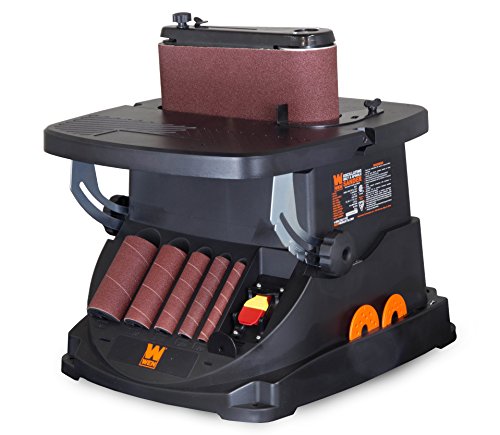
The WEN 6524 is not a pure spindle sander, and it should not be bought as one. It is a combination machine pairing an oscillating spindle with a belt sanding station, so one bench footprint covers curved edges and flat, straight work. That suits a small shop where a separate belt sander would have nowhere to live.
The listing confirms a 3.5 amp motor with a maximum rotational speed of 2,000 RPM and 80-grit abrasives fitted. At 27 pounds and 18.5 by 16.5 by 18 inches, it asks for more bench depth than a spindle-only machine — the honest trade for the second station. Setup discipline matters more, not less: disconnect the power before changing drums and belts, follow the maker’s directions for each station, and keep extraction connected.
| Brand | Product | ASIN | Key specs |
|---|---|---|---|
| WEN | WEN 6524 Oscillating Belt and Spindle Sander | B07MJ7X6D6 | Belt and spindle combination machine; 3.5 A motor; maximum rotational speed 2,000 RPM; 80-grit abrasives; 27 lb; 18.5 x 16.5 x 18 in.; corded electric |
JET JBOS-5 Benchtop Oscillating Spindle Sander
The JET JBOS-5 is the step up for woodworkers who sand bevelled curves, because its 14-1/2 by 14-1/2 inch table tilts from 0 to 45 degrees. Tilting the table instead of the work lets an angled edge ride flat against the drum, far easier to control than holding a bevelled part at an angle by hand. The 1/2 HP motor runs on 115 volt, single-phase power at 1,725 RPM, with 30 oscillations per minute over a full 1 inch oscillation length — a longer stroke than most benchtop rivals.
The spindle assortment covers 1/4, 1/2, 5/8, 1-1/2 and 2 inch assemblies, reaching tighter radii than sets that start at 1/2 inch, and four table inserts — two round, two oblong — support the work close to the abrasive. The listing states 100-grit abrasives and describes a five-year warranty.
| Brand | Product | ASIN | Key specs |
|---|---|---|---|
| JET | JET Benchtop Oscillating Spindle Sander, 1/2 HP, 115V 1Ph (Model JBOS-5) | B00005A3GW | 1/2 HP, 115 V, 1-phase motor; 1,725 RPM; 30 oscillations per minute; 1 in. oscillation length; table 14-1/2 x 14-1/2 in. tilting 0 to 45 degrees; spindle assemblies 1/4, 1/2, 5/8, 1-1/2 and 2 in.; four table inserts; 100-grit |
VEVOR OSM-1 Oscillating Spindle Sander
The VEVOR OSM-1 is the compact, lighter-duty entry in this line-up. Its spindle runs at 2,000 RPM with a 0.59 inch stroke, and the cast aluminum table measures 12.5 by 11.5 inches — smaller than the cast iron tables above, but easier to lift on and off a crowded bench. Six sanding sleeves span 1/2 inch to 3 inches, with six matching table inserts.
Integrated storage slots keep the sleeves and inserts with the machine, and the dust port measures 1.38 inches inside diameter and 1.54 inches outside diameter as printed in the listing, so check your vacuum hose fitting against those figures. This is the pick for occasional curve sanding — craft projects, furniture repairs, small DIY work — rather than daily production use. The same rules apply: extraction connected, eye protection on, a dust mask worn as the maker directs, power disconnected before any drum change.
| Brand | Product | ASIN | Key specs |
|---|---|---|---|
| VEVOR | VEVOR Oscillating Spindle Sander, 2000RPM Benchtop Spindle Sander with 6 Sleeves (Model OSM-1) | B0FQZYXTLN | 2,000 RPM; 0.59 in. (15 mm) stroke; six sleeves 1/2 to 3 in.; six table inserts; cast aluminum table 12.5 x 11.5 in.; dust port 1.38 in. ID / 1.54 in. OD; integrated storage slots |
RIDGID EB4424 Oscillating Edge Belt and Spindle Sander
Like the WEN 6524, the RIDGID EB4424 is a combination machine — an oscillating edge belt and spindle sander in one unit — included on those terms, not as a dedicated spindle sander. It is the stronger of the two combos: a 5 amp, 3/8 HP motor drives the spindle at 1,725 RPM and the belt at 1,350 feet per minute, with 60 oscillations per minute over a 3/4 inch stroke. The belt is a standard 4 by 24 inch size, and the sleeves cover 1/2, 3/4, 1, 1-1/2 and 2 inches.
Its table tilts from 0 to 48 degrees with detents at 0, 15, 22.5, 30 and 45 degrees, so common bevel angles click into place repeatably — a genuine advantage for batch work. The trade-off is more setup steps when switching modes, and drum changes done with the power disconnected, exactly as RIDGID directs.
| Brand | Product | ASIN | Key specs |
|---|---|---|---|
| RIDGID | Ridgid EB4424 Sander, Oscillating/Edge Belt | B0015B9G0S | Belt and spindle combination machine; 5 A; 3/8 HP; spindle speed 1,725 RPM; belt speed 1,350 FPM; 60 oscillations per minute; 3/4 in. stroke; 4 x 24 in. belt; sleeves 1/2, 3/4, 1, 1-1/2 and 2 in.; table tilts 0 to 48 degrees with detents at 0, 15, 22.5, 30 and 45 degrees |
How to Choose
Start with drum diameters, because they set the tightest curve the machine can sand. The inside radius of your work must be larger than the drum you use, so a set starting at 1/4 inch handles scrollwork and small cut-outs that a 1/2 inch minimum set cannot reach. Count the sleeves and drums actually included, not the sizes the machine merely accepts.
Next, weigh stroke and oscillation. A longer stroke — 1 inch on the JET against 0.59 inch on the VEVOR — spreads wear over more of the sleeve, so abrasives last longer and the finish stays consistent. Table size and tilt come after: a larger table supports bigger workpieces, and a tilting table is the deciding feature for bevelled edges.
Then decide dedicated versus combination. A dedicated spindle sander does one job with fewer setup steps; a combo trades setup time for a second sanding station in the same footprint. Finally, plan dust control before buying: check the port size against your vacuum hose. Whatever you choose, follow the maker’s directions, wear eye protection and a dust mask as directed, and disconnect the power for every drum change.
Who Should Skip
Skip the category entirely if your sanding is all flat and straight — a belt sander or random orbit sander is the right tool there. Skip the benchtop class if you run a production shop shaping large parts daily; a floor-standing machine is the honest fit. Skip the combination machines if you will never use the belt station. And skip every pick here if dust extraction is not an option in your workspace: these machines produce fine dust at bench height, and using one without extraction, a mask and eye protection is not a reasonable way to work.
FAQ
What does the oscillation actually do?
As the drum spins, it also travels up and down through its stroke. That keeps the workpiece from contacting the same band of abrasive continuously, which reduces heat, slows clogging, spreads wear across the sleeve and leaves a smoother edge.
Which drum size should be used for a tight inside curve?
Use the largest drum that fits inside the curve with a little room to move. A drum nearly equal to the radius gives the most support and the smoothest result, while a much smaller drum makes it easy to sand hollows into the edge. This is why sets including a 1/4 or 1/2 inch drum matter for scrollwork.
Is a belt and spindle combo a real substitute for a dedicated spindle sander?
For spindle work, yes — the two combos here oscillate and take standard sleeves just as the dedicated machines do. The difference is workflow: switching modes adds setup steps, and each change must be made with the power disconnected, following the maker’s directions. If nearly all your sanding is curved work, a dedicated machine is simpler; if projects mix flat edges and curves, the combo earns its space.
What safety steps matter most when changing drums or sleeves?
Disconnect the power first, every time, and let the spindle stop fully before touching it. Keep the correct table insert fitted, connect dust extraction before sanding, and wear eye protection and a dust mask as the maker directs. Hold workpieces flat and supported as instructed, and never treat any guard or feature as a guarantee.
Final Verdict
For most home workshops, the WEN 6510T is the balanced choice: the widest included sleeve range, a cast iron table, onboard storage and a dust port, with no mode switching. Choose the JET JBOS-5 if bevelled edges are regular work, since its tilting table and 1 inch stroke are built for exactly that. Pick the VEVOR OSM-1 for occasional craft and repair sanding where compact size matters most. And if one machine must cover flat edges as well as curves, the RIDGID EB4424 is the stronger combo, with the WEN 6524 as its same-format alternative.