Key takeaways
- Compare pin and pinless moisture meters for wood and drywall, with guidance on reading depth, species settings, displays and which type fits your project.
- Top Pick: General Tools MMD4E Digital Moisture Meter
- Runner-up: General Tools MMD4E Digital Moisture Meter
- Also consider: General Tools MMD4E Digital Moisture Meter
A moisture meter answers a question your eyes cannot: is this board, wall or floor actually dry, or just dry on the surface? Guessing wrong has real costs. Lumber milled, glued or finished while still damp can warp, cup or split weeks later. Drywall that feels dry after a leak can still hold moisture deep in the panel, and paint or filler applied over it tends to fail. A meter turns that guesswork into a reading you can act on.
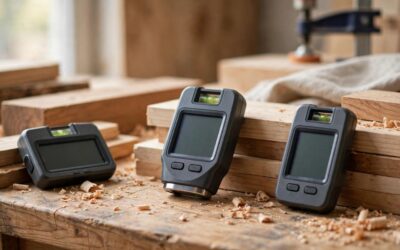
The buying decision starts with one fork in the road: pin or pinless. Pin meters drive two small probes into the material and measure electrical resistance between them, which suits precise spot checks in wood. Pinless meters use a flat sensor pad and scan without leaving holes, which suits finished surfaces and walls. This guide explains how to choose, and how reading depth changes what a number means.
As an Amazon Associate, we earn from qualifying purchases.
Quick answer
Choose a pin meter for precise spot readings in lumber and firewood, where two small probe holes do not matter. Choose a pinless meter for drywall, finished flooring and painted surfaces you cannot mark. Check reading depth, set the species or material mode correctly, and treat drywall numbers as relative comparisons between spots, not absolute values.
General Tools MMD4E Digital Moisture Meter
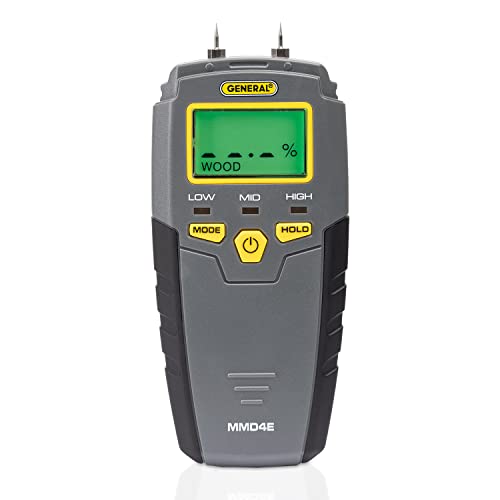
The MMD4E is the classic pin-type starting point. Two replaceable pins, each 8 mm long, are pressed into the material, and the meter reads the resistance between them. It covers wood on a scale running from 5 to 50, and building materials such as drywall on a separate scale from 1.5 to 33, with readings shown in fine steps of one tenth on a backlit LCD.
Audible and visual alerts flag high, medium and low moisture levels, so you can sweep a board or wall patch and listen for the change instead of watching the screen. A 9V battery and spare pins are included, the spares useful because pins bend and dull with use. Published accuracy figures for this model vary between listings, so treat it as a dependable indicator rather than a laboratory instrument, and buy from an established seller, since look-alike units circulate.
| Spec | Detail |
|---|---|
| Type | Pin type, two replaceable 8 mm pins |
| Wood scale | 5 to 50 |
| Building material scale | 1.5 to 33 |
| Display | Backlit LCD, audible and visual alerts |
| Power | 9V battery, included |
| Extras | Spare pins included |


Klein Tools ET140 Pinless Moisture Meter
The ET140 takes the opposite approach: no pins at all. Its electromagnetic sensor pad sits flat against the surface and detects moisture up to three quarters of an inch below it, so you can scan a drywall panel, a masonry surface or a finished board without leaving a mark. Modes for drywall, masonry, hardwood and softwood adjust how readings are interpreted, and results show on a relative scale from 0 to 100.
That relative scale is the key idea to understand. On drywall and masonry, the ET140 gives an indication you compare from spot to spot: a reading that jumps sharply near a stain or a pipe run tells you where moisture is concentrated, even though the number itself is not an absolute moisture content value. For leak hunting, that comparison is often more useful than a single precise figure. If your main job is checking walls after plumbing work, leaks or flooding, this is the natural pick of the five.
| Spec | Detail |
|---|---|
| Type | Pinless electromagnetic sensor pad |
| Sensing depth | Up to three quarters of an inch below the surface |
| Material modes | Drywall, masonry, hardwood, softwood |
| Display | Relative scale from 0 to 100 |
| Power | 9V battery |
| Surface damage | None, non-destructive scanning |
Wagner Meters Orion 950 Pinless Wood Moisture Meter

The Orion 950 is the specialist here, built for people whose work depends on the moisture content of wood: furniture makers, flooring installers and serious hobbyists. It is pinless, so it will not puncture veneer, finished table tops or hardwood blanks, and it measures at two depth settings, a shallow scan for surface conditions and a deeper scan for thicker stock. That dual-depth reading separates a board that is merely surface-dry from one dry all the way through.
Its other defining feature is species adjustment. Wood density varies widely between, say, balsa and ipe, and a pinless meter needs to know which species it is scanning to interpret the signal. The Orion 950 lets you set the species so readings stay meaningful across the lumber a workshop handles. It is a wood-focused instrument rather than a wall scanner, so drywall work is better served by the other pinless picks here.
| Spec | Detail |
|---|---|
| Type | Pinless, non-invasive |
| Depth | Dual-depth measurement, shallow and deep settings |
| Calibration | Species-adjustable for different wood densities |
| Best for | Lumber, flooring and finished wood surfaces |
| Surface damage | None |
RDINSCOS MT93 Pin-Type Moisture Meter
The MT93 is a modern take on the pin meter. It keeps the two-probe design, with replaceable pins, but adds a large color display that is easy to read at arm’s length and in awkward positions. An automatic alarm warns when a reading crosses into the wet zone, and a HOLD function freezes the number on screen so you can pull the meter out of a tight space and read it after.
It is also rechargeable, removing the slow drain of disposable batteries that leaves so many workshop meters dead the day they are needed. The alarm, calibration and hold functions and the color screen put it a step above basic pin meters in convenience, while the measuring principle stays the same: precise at the point where the pins enter, and limited to roughly the depth the pins reach. Choose it if you like pin-meter spot checks but want a clearer display and one less battery to think about.
| Spec | Detail |
|---|---|
| Type | Pin type, replaceable pins |
| Display | Large color display |
| Functions | Automatic alarm, calibration, HOLD |
| Power | Rechargeable |
| Best for | Spot checks in wood and building materials |
General Tools MMD7NP Pinless Moisture Meter

The MMD7NP is the straightforward pinless option from General Tools. A flat pad sensor is pressed against the surface and scans the material beneath it without pins, holes or surface damage, making it a sensible choice for drywall, finished wood and any surface a homeowner does not want to puncture. It suits the classic home scenario: a stain appears or a pipe has been repaired, and you need to know whether the damp patch is shrinking or quietly spreading.
Used that way, as a comparison tool, it earns its place. Scan the stained area, then scan a clearly dry section of the same wall, and the difference between the readings tells the story. It is a simpler instrument than the trade-oriented pinless models above, but for routine home checks that is a fair trade.
| Spec | Detail |
|---|---|
| Type | Pinless pad sensor, non-invasive |
| Best for | Drywall and wood surface scanning |
| Surface damage | None |
| Use style | Comparing damp and dry areas of the same surface |
How to choose
Start with the surface you cannot afford to mark. Finished floors, painted drywall and furniture-grade boards rule out pins, which points to a pinless model. Rough lumber, firewood and hidden framing tolerate two small holes, and a pin meter gives a direct reading there.
Next, think about reading depth. Pins only measure as deep as they are inserted, so short pins report on the outer layer of a board; thick lumber can read dry on the surface while the core is still wet. Pinless meters sense a volume of material down to their rated depth, three quarters of an inch for the ET140, and dual-depth models like the Orion 950 let you compare shallow and deep readings on one board.
Then match the meter to the material. Wood readings are only meaningful when the species or density setting matches the board in front of you, which is why adjustable models matter for mixed lumber. On drywall and masonry, treat every reading as relative: the value lies in comparing a suspect spot against a known dry spot on the same surface. Finally, weigh the everyday details: a backlit or color display, an alarm for fast sweeps, replaceable pins, and a battery style you will actually keep charged.
Who should skip
Skip the premium pinless wood meters if your only task is checking whether firewood is seasoned; a basic pin meter answers that for far less cost. Skip pinless-only meters if your work demands a precise reading at one exact point inside thick lumber, since a scanning average can hide a wet pocket. And skip buying any meter as the response to an active, ongoing leak: shut off the water and fix the source first, then use a meter to confirm the drying. A meter measures; it does not dry or repair anything on its own.
FAQ
Is a pin or pinless meter better for drywall?
Pinless, in most home situations. Drywall is soft and finished, so pins leave visible holes and only sample one tiny point. A pinless meter scans a broad area without damage, which suits mapping a damp patch. Just remember the drywall reading is relative: compare it against a dry area of the same wall rather than treating it as an absolute value.
How deep does a moisture meter actually read?
Only as deep as its design allows. A pin meter reads at the depth the pins reach, which for short pins is the outer layer of the material. A pinless meter senses down to its rated depth, up to three quarters of an inch below the surface for the ET140. Moisture deeper than that, in the middle of a thick beam or inside a wall cavity, can go undetected, so check from both sides where possible.
Why do readings vary across the same board or wall?
Because moisture is rarely evenly distributed. The end grain of a board dries faster than the middle, the bottom of a wall panel wicks more water than the top, and surface condensation can lift a reading unrelated to the core. Species settings and how firmly a pinless pad sits also shift results. Take several readings and re-check over a few days to see which way the numbers are moving.
Final verdict
Match the meter to the material and the surface. For walls, stains and leak checks where holes are not acceptable, a pinless meter such as the Klein Tools ET140 or the General Tools MMD7NP is the right tool, used comparatively against dry reference spots. For lumber precision, the Wagner Meters Orion 950 brings species settings and dual-depth scanning, while the General Tools MMD4E and the rechargeable RDINSCOS MT93 cover pin-style spot checks. Whichever type you choose, depth and material settings decide whether the number means anything, so read patterns, not single points.