Key takeaways
- Forstner bits vs spade bits compared: clean flat-bottom holes for cabinetry or fast rough boring for framing runs, with five verified sets compared.
Ask a workshop which bit bores the cleaner hole and the answer is settled before the drill even spins up. A Forstner bit is guided by its rim, so it shears a tidy circle, leaves a flat bottom, and can start on an angle or overlap an earlier hole without wandering. A spade bit is guided by its center point, so it pulls through stock quickly and cheaply in spirit, but leaves rougher walls and a pointed mark at the bottom. The two families fit the same chucks, yet they are built for opposite kinds of work.
This guide compares the two designs head to head, then walks through five sets worth shortlisting: three Forstner sets for furniture and cabinet work, and two spade sets for fast through-holes in framing and rough stock. It also covers how to choose by hole finish, drill type, and material, plus the shop habits that apply to both families, including securing the workpiece, wearing eye protection, and following the bit maker’s speed guidance for the diameter and material being bored.
As an Amazon Associate, we earn from qualifying purchases.
Quick answer
Choose Forstner bits when the hole must look finished: flat bottoms, clean rims, overlapping or angled holes for cabinetry and furniture. Choose spade bits when the hole just needs to exist quickly: wiring and plumbing runs through framing, where speed matters and the hole stays hidden. Most workshops end up owning both families in the end.
Fisch Wave Cutter Forstner Bit Set, 16-Piece
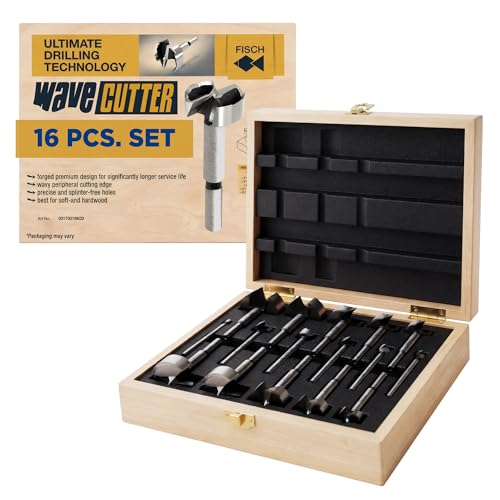
The Fisch set is the clean-hole benchmark in this roundup. Its Wave Cutter rim uses a serrated, wavy edge that slices wood fibers at the circumference before the interior is cleared, which is how the listing supports its splinter-free cutting claim. That rim-guided action is exactly what makes Forstner bits behave: the hole starts where you place it, the walls come out smooth, and the bottom stays flat enough for hinge cups, clock inserts, and dowel joinery. The bits are high speed steel with straight shanks, and the sixteen sizes run from small dowel work up to wide furniture holes. Fisch lists engineered wood as the recommended surface, which suits cabinet carcasses, shelving, and shop-built jigs in sheet goods. If your boring is mostly visible work in plywood and hardwood panels, this is the set to build around.
| Brand | Product | ASIN | Key specs |
|---|---|---|---|
| Fisch | Wave Cutter Forstner Bit Set, 16-Piece (FSA-196037) | B07VZXHGXK | 16 pieces; diameters 1/4 inch to 2-1/8 inch; high speed steel; straight shank; serrated Wave Cutter rim for splinter-free cutting; surface recommendation: engineered wood |
Freud PB-100 Precision Shear Forstner Bit Set, 16 Pieces
Freud’s PB-100 covers the same wide diameter span as the Fisch, also in sixteen pieces, but takes a slightly different route to a clean edge. The Precision Shear design pairs a serrated edge with a center point, so the bit registers positively on your layout mark and then shears the rim as it feeds. That combination is forgiving on handheld starts and very controllable in a drill press, where Forstner bits do their best work: flat-bottomed mortises, stopped holes that must not break through, and overlapping holes for carved or scalloped details. The shanks are straight, matching standard chucks and press setups. Woodworkers who bore a lot of hardwood furniture parts tend to like a shear-style edge because it keeps the rim crisp as diameters grow. Between this and the Fisch, the honest difference is edge design and brand preference rather than coverage, since both sets span the same range.
| Brand | Product | ASIN | Key specs |
|---|---|---|---|
| Freud | PB-100 Precision Shear Forstner Bit Set, 16 Pieces | B0002TUFYK | 16 pieces; diameters 1/4 inch to 2-1/8 inch; Precision Shear serrated edge; center point style; straight shank |
Bosch DSB5013P 13-Piece Daredevil Spade Bit Set in Pouch

Swing to the spade side and the priorities flip from finish to feed rate. Bosch’s Daredevil set uses a full-cone threaded tip that pulls the bit through the material, so the operator steers rather than forces it, and the contoured paddle clears chips as it goes. Spur and reamer tips score the hole’s edge while angled cutting edges help reduce blowout on the exit side, though a spade hole will never rival a Forstner hole for finish. The quarter-inch hex power-groove shank works in impact drivers as well as drill/drivers, which is why sets like this live on job sites: they bore through wood and treated lumber for cable, pipe, and conduit runs all day. Thirteen pieces arrive in a pouch, spanning the common framing sizes from small pilot work up to generous utility holes. Clamp or firmly hold smaller stock, because a self-feeding tip can grab and twist a loose workpiece.
| Brand | Product | ASIN | Key specs |
|---|---|---|---|
| Bosch | DSB5013P 13-Piece Daredevil Spade Bit Set in Pouch | B002GU6QAA | 13 pieces in pouch; diameters 1/4 inch to 1-1/2 inch; 1/4 inch hex power-groove shank for impact drivers and drill/drivers; full-cone threaded tip; spur and reamer tips; contoured paddle for chip removal; for wood and treated lumber |
IRWIN Marples Forstner Bit Set, 14 Pieces (1966893)

The Marples set brings the Forstner count to three and aims squarely at fine woodworking and cabinet making, as its listing states. Fourteen carbon steel bits cover the range most furniture projects actually use, from small dowel and pin holes up to two-inch boring for hardware and joinery. A brad point registers the bit precisely on a marked center, and the straight shanks seat in any standard chuck or drill press. Carbon steel edges are easy to maintain with a file and hold up well in the hardwoods and sheet goods cabinetmakers bore most, provided you keep speeds sensible and let the rim do the cutting rather than leaning on the drill. Choose this set if your work is traditional furniture and cabinetry in solid wood, where the slightly narrower top end rarely matters and the brad-point starts keep layouts honest on visible faces.
| Brand | Product | ASIN | Key specs |
|---|---|---|---|
| IRWIN | Marples Forstner Bit Set, 14 Pieces (1966893) | B071S1BGXV | 14 pieces; diameters 1/4 inch to 2 inches; carbon steel; brad point style; straight shank; made for fine woodworking and cabinet making |
IRWIN SPEEDBOR Blue-Groove Pro Spade Bit Set, 3-Piece (87950)
Not every spade job needs a full pouch of sizes. This compact three-piece SPEEDBOR set covers the small jobs: a quick pass-through for a cable, a latch or lock boring in a door blank, a hole in a stud bay during a remodel. The Blue-Groove point and cutting edge are designed for faster chip removal, and double cutting spurs scribe the outside of the circle before the paddle clears the middle, which reduces breakout compared with a plain flat bit. The grooved hex shank locks into quick-change holders and impact drivers. Because the three diameters are the whole point of a set this small, confirm on the listing that they match the holes on your list before ordering. Kept in a toolbox or truck box, it is the grab-and-go option next to the larger Bosch pouch, and a sensible first spade purchase for occasional drilling.
| Brand | Product | ASIN | Key specs |
|---|---|---|---|
| IRWIN | SPEEDBOR Blue-Groove Pro Spade Bit Set, 3-Piece (87950) | B00004YO9W | 3 pieces; hex shank; Blue-Groove point style; double cutting spurs scribe the hole to reduce breakout; grooved hex shank for quick-change holders |
How to Choose
Start with the hole, not the bit. If the bottom must be flat, the rim visible, or the hole stopped at a precise depth, only a Forstner bit qualifies; if the hole passes through framing and disappears behind drywall, a spade bit’s speed wins and its rough finish costs nothing. Next, match the tool to the drill. Forstner bits reward a drill press, where the rim stays square to the work, while the hex-shank spade sets here also run happily in impact drivers for overhead and in-wall work.
Then check diameter coverage against your real projects: cabinet hardware and joinery live in the wide Forstner ranges above, while framing runs cluster in the spade range. Shank style matters too: straight shanks suit chucks and presses, hex power-groove shanks suit quick-change holders. Finally, work safely whichever family you pick. Secure the workpiece with clamps rather than a free hand, wear eye protection, and follow the bit maker’s speed guidance for the bit diameter and material being bored, easing off as the bit breaks through to limit tear-out.
Who should skip
Skip Forstner sets if your drilling is entirely rough framing and utility runs; you will pay for finish you never see, and spade bits bore those holes faster. Skip spade bits if your holes are visible furniture or cabinet work, because no technique fully hides their rougher walls and center-point mark. Skip both families if you mainly bore deep holes in thick beams, where long auger bits are the right tool, or if you drill metal, where neither design belongs. And skip a large set if you only ever bore one diameter: a single bit in that size, plus a small starter set later, is the leaner buy.
FAQ
Can a spade bit drill a flat-bottomed hole?
Not truly. A spade bit’s center point protrudes ahead of its cutting edges, so the bottom of a stopped hole carries a pointed mark and the walls come out rougher than a Forstner hole. For a genuinely flat bottom that seats hardware cleanly, use a Forstner bit.
Can Forstner bits drill angled or overlapping holes?
Yes, and this is their signature advantage. Because the rim guides the cut instead of a center point sunk in solid wood, a Forstner bit can start at an angle and can overlap an existing hole. A spade bit needs its point anchored in full material, so it skates or grabs in the same situations.
Which family works better in a drill press?
Forstner bits, by a wide margin. The press holds the rim-guided bit square and steady, which produces the cleanest walls and flattest bottoms, especially at larger diameters. Spade bits work in a press too, but their self-feeding tips and rough cut are designed around handheld drills and drivers.
How do I reduce tear-out when a bit exits the back of the board?
Clamp a sacrificial backer board tightly behind the workpiece so the bit exits into wood instead of air, keep the work clamped rather than hand-held, and ease off feed pressure as breakthrough approaches. The spurs on the spade sets above also scribe the circle first, which helps the exit side stay tidier.
Final Verdict
Cleaner holes are not a matter of brand loyalty; they are a matter of geometry. Forstner bits win every visible, flat-bottomed, or precision hole, and the Fisch, Freud, and IRWIN Marples sets cover that ground with wide ranges and tidy edges. Spade bits win every hidden through-hole where minutes matter, and the Bosch Daredevil pouch and the compact IRWIN SPEEDBOR set cover framing and small jobs respectively. Pick the family that matches the holes on your project list, keep the work clamped and your eyes protected, and most workshops will sensibly end up owning one set of each.