Key takeaways
- Rotary hammer vs hammer drill, compared by mechanism: piston impact energy, SDS-Plus chucks and cam action, with five picks for concrete and masonry.
Rotary hammer vs hammer drill sounds like a small distinction, but the two tools work in completely different ways, and picking the wrong one makes concrete work slow and hard on bits. A rotary hammer drives a piston that strikes the bit with a rated amount of energy on every blow. A hammer drill spins a chuck like an ordinary drill and adds a rapid tapping action from two ridged discs, so each hit is weak and drilling depends on how hard you push.
That difference decides everything else: the chuck, the bits, the hole sizes each tool handles, and whether light chipping is possible. This guide explains the split, then walks through three SDS-Plus rotary hammers and two corded hammer drills.
As an Amazon Associate, we earn from qualifying purchases.
Quick answer
Choose a rotary hammer for repeated holes in cured concrete, larger anchors, overhead work or light chipping: its piston delivers rated impact energy on every blow. Choose a hammer drill for brick, block and mortar, occasional small anchors, and everyday drilling in wood and steel. The chuck tells the story: SDS-Plus means rotary; a standard chuck means hammer drill.
Bosch 11255VSR Bulldog Xtreme Rotary Hammer
The Bulldog Xtreme is the reference point for 1-inch SDS-Plus rotaries: a corded tool built around an 8.0 amp motor and a pneumatic piston delivering 2.0 ft-lbs of impact energy per blow. Because the energy comes from the piston rather than your arms, anchor holes in cured concrete go in at a steady pace without leaning on the tool. Its three modes include a hammer-only setting with Vario-Lock chisel positioning (36 positions) for light chipping like tile removal.
An integral clutch disengages the drive if a bit binds in rebar or aggregate. At 6.7 lb it is manageable overhead for short runs, and being corded it never waits on a battery. Per the manufacturer’s instructions, use eye and hearing protection, hold the side handle with both hands, and control silica dust with an extraction setup such as Bosch PRO+GUARD where fitted.
| Spec | Detail |
|---|---|
| Brand / Product | Bosch 11255VSR Bulldog Xtreme Rotary Hammer |
| ASIN | |
| Type / Motor | Corded rotary hammer, 120V, 8.0 amp |
| Impact energy | 2.0 ft-lbs (EPTA) |
| Speed | 0–1,300 RPM; 0–5,800 BPM |
| Chuck / Modes | SDS-Plus, 1-inch; rotation only, rotary hammer, hammer only; 6.7 lb tool |
| Included | Side handle, depth gauge, carrying case |
Milwaukee 2912-20 M18 FUEL Rotary Hammer
The 2912-20 brings the same 2.0 ft-lbs impact energy class as the corded Bosch, but on Milwaukee’s M18 battery platform with a brushless motor. It spins 0–1,330 RPM with 4,800 blows per minute, and its three modes cover the same drilling and light chipping range. For overhead anchor work or moving around a site cord-free, that freedom is the whole point.
AUTOSTOP shuts the tool down when it senses a bind-up in rebar or aggregate, and the AVS anti-vibration system reduces what reaches your hands over long runs. Milwaukee rates it at up to 125 holes of 3/8 inch by 2 inches per charge with an M18 REDLITHIUM HIGH OUTPUT XC6.0 battery. Note the fine print: this is a bare tool, so battery and charger are separate purchases, and 6.8 lb is tool-only weight.
| Spec | Detail |
|---|---|
| Brand / Product | Milwaukee 2912-20 M18 FUEL SDS-Plus Rotary Hammer |
| ASIN | B09PMSKXRV |
| Type / Power | Cordless rotary hammer, bare tool; M18 battery (not included) |
| Motor / Impact energy | Brushless; 2.0 ft-lbs |
| Speed | 0–1,330 RPM; 4,800 BPM |
| Chuck / Modes | SDS-Plus, 1-inch; rotary hammer, hammer only, rotary only; 6.8 lb tool only |
DEWALT DCH273B 20V MAX Rotary Hammer
DEWALT’s DCH273B is the comparable bare-tool rotary for the 20V MAX platform: a brushless, L-shaped 1-inch SDS-Plus hammer rated at 2.1 joules of impact energy and 0–1,100 RPM. Its three modes — drill, hammer drill and chip — cover plain drilling, rotary hammer work and light chipping.
The SHOCKS Active Vibration Control system reduces vibration at the handles over long runs, and the design sits in DEWALT’s Perform & Protect line for bind-up and dust control. Like the Milwaukee, it is a bare tool only, aimed at readers who already own 20V MAX batteries. Use only correct platform batteries, keep both hands on the tool with the side handle fitted, and follow DEWALT’s dust-extraction instructions.
| Spec | Detail |
|---|---|
| Brand / Product | DEWALT DCH273B 20V MAX SDS Rotary Hammer |
| ASIN | B00YDZI9BA |
| Type / Power | Cordless rotary hammer, bare tool; 20V MAX battery (excluded) |
| Motor / Impact energy | Brushless; 2.1 joules |
| Speed | 0–1,100 RPM |
| Chuck / Modes | SDS-Plus, 1-inch; drill, hammer drill, chip; 6.4 lb tool only |
DEWALT DWD520 Hammer Drill
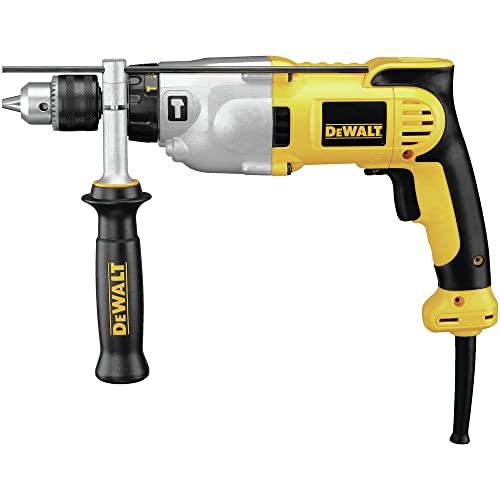
Crossing to the hammer-drill side, the DWD520 is a corded, pistol-grip drill first and a masonry tool second. Its 10 amp motor drives a standard 1/2-inch chuck across two speed ranges (0–1,200 and 0–3,500 RPM), with a dual-mode selector for plain drilling or hammer drilling. In hammer mode the cam action taps the bit forward thousands of times a minute — enough for brick, block, mortar and the occasional small anchor hole in softer concrete, but a different league from piston energy.
Its standard chuck takes the round-shank bits you already own, plus carbide masonry bits for hammer work, and handles ordinary drilling in wood and steel. There is no hammer-only mode, so it cannot chip, and it carries no piston impact-energy rating — judge it on speed ranges, chuck and capacity. This listing is the tool only, not a kit, with no carrying case included.
| Spec | Detail |
|---|---|
| Brand / Product | DEWALT DWD520 Hammer Drill, Pistol Grip |
| ASIN | B003YL4990 |
| Type / Motor | Corded hammer drill, tool only; 10 amp, 120V |
| Speed | Two ranges: 0–1,200 / 0–3,500 RPM |
| Chuck / Modes | 1/2-inch standard chuck (round-shank bits); drill, hammer drill |
| Capacities / Included | Masonry about 3/4 inch; wood 1.5 inch; steel 1/2 inch; side handle, chuck key, depth rod |
Bosch 1191VSRK Hammer Drill Kit
The 1191VSRK is the light, simple end of the hammer-drill idea: a 7.0 amp corded drill weighing just 4.1 lb, with a 1/2-inch keyed chuck and a two-position selector for rotation only or hammer drilling. It delivers 0–3,000 RPM and 0–48,000 BPM in hammer mode. That BPM figure looks enormous next to the rotaries above, but cam-action blows are individually tiny, so the count is high while per-blow energy stays low. More blows does not mean more power.
Bosch rates its maximum capacities at 5/8 inch in concrete, 1/2 inch in steel and 1-1/2 inches in wood, which frames it honestly: a household and light-trade drill for brick, block and modest concrete work that spends most of its life as a normal drill.
| Spec | Detail |
|---|---|
| Brand / Product | Bosch 1191VSRK Single-Speed Hammer Drill Kit |
| ASIN | B000VZJGAO |
| Type / Motor | Corded hammer drill kit, 120V; 7.0 amp |
| Speed | 0–3,000 RPM; 0–48,000 BPM in hammer mode |
| Chuck / Modes | 1/2-inch keyed chuck (round-shank bits); rotation only, hammer drill |
| Max capacities / Weight | Concrete 5/8 inch; steel 1/2 inch; wood 1-1/2 inch; 4.1 lb |
How to Choose
Start with the material and the hole count. If the work is repeated anchor holes in cured concrete, holes above roughly 1/2 to 5/8 inch, overhead drilling, or any light chipping, the rotary hammer’s piston is the right call. If the work is brick, block and mortar, occasional small anchors, and ordinary drilling in wood and steel, a hammer drill covers it while staying lighter.
For rotaries, compare impact energy first — 2.0 ft-lbs on the Bosch and Milwaukee, 2.1 joules on the DEWALT — then speed, capacity and weight. For hammer drills, compare speed ranges, chuck and stated capacities, and never line a hammer drill’s BPM up against a rotary’s as if the bigger number meant a stronger blow; per-blow energy is the real difference. Chuck decides your bits too: SDS-Plus locks into rotaries and changes without tools, while hammer drills reuse standard round-shank bits. Neither type fits the other chuck.
Finally, count the platform cost. The corded Bosch drills all day with no batteries to manage, while both cordless rotaries here are bare tools that reward readers who already own their batteries. Whichever side you land on, follow the manufacturer’s instructions: eye and hearing protection for all hammer work, a properly fitted respirator where the manual and local rules require one, dust extraction for concrete drilling, and the side handle with both hands.
Who should skip
Skip the rotary hammer if your masonry work stops at hanging pictures in brick or block, or if most drilling is wood and steel — a hammer drill, or even a plain drill-driver, is lighter and uses bits you already own. Skip the hammer drill if the job means repeated holes in cured or structural concrete, diameters much above 1/2 to 5/8 inch, or any chipping; it will run slow and hot, and punish bits and wrists. Skip both cordless bare tools if you own no batteries on their platforms.
FAQ
Can a hammer drill replace a rotary hammer for concrete anchors?
Only for the occasional small hole in softer material. A hammer drill’s cam action depends on you pushing hard and delivers very little energy per blow, so repeated anchors in cured concrete go slowly and wear bits fast. A rotary hammer’s piston delivers rated energy on every blow regardless of pressure.
Why does the Bosch hammer drill list 48,000 BPM while the rotaries list far fewer?
Because the blows are not comparable. The hammer drill’s ridged discs produce tens of thousands of tiny taps per minute, while a rotary hammer’s piston produces a few thousand heavy strikes, each with a published impact-energy rating. Judge rotaries by impact energy — never by BPM across types.
Do SDS-Plus bits fit a hammer drill, or the other way around?
No, in either direction. SDS-Plus shanks lock into a rotary hammer’s chuck and slide slightly so piston energy transfers into the bit. Hammer drills grip smooth round-shank bits in a standard chuck. Each tool needs its own bit set, and adapters defeat the mechanism that makes the rotary work.
Are the Milwaukee and DEWALT rotaries ready to use out of the box?
No. Both are bare tools, sold without a battery or charger, for owners of the M18 and 20V MAX platforms respectively. If you do not run one of those platforms, factor batteries into the decision, or choose the corded Bosch.
Final Verdict
Rotary hammer vs hammer drill comes down to mechanism. For cured concrete, repeated anchors and light chipping, a rotary hammer is the only serious option: the corded Bosch 11255VSR for sustained work, or the Milwaukee 2912-20 or DEWALT DCH273B if you already own their batteries. For brick, block and mixed household drilling, the DEWALT DWD520 brings more muscle while the Bosch 1191VSRK kit stays light. Match the piston or the cam to your wall.