Key takeaways
- Compare five bench grinders for home workshops, from slow-speed sharpening models to compact 6-inch grinders, with wheel, speed and safety guidance.
A bench grinder earns its place in a home workshop by doing a short list of jobs well: restoring a nicked chisel edge, sharpening mower blades and garden tools, cleaning rust and burrs off hardware, and shaping small metal parts. The right model depends less on raw power than on wheel size, wheel speed, and whether the machine runs cool enough for delicate edges.
This guide compares five grinders that cover the main home-workshop situations: a full-size 8-inch workhorse, two variable and slow-speed 8-inch sharpening machines, and two compact 6-inch options for smaller benches.
As an Amazon Associate, we earn from qualifying purchases.
Quick answer
For most home workshops, an 8-inch grinder with a slow or variable speed range is the most useful choice, because slower wheels sharpen chisels and plane irons without overheating the edge. The DEWALT DW758 suits heavy stock removal, the WEN BG4286 is built for sharpening, and the WEN BG4276 fits small benches and light tool care.
DEWALT Bench Grinder, 8-Inch, 3/4 HP, 3,600 RPM (DW758)

The DW758 is the traditional full-size bench grinder in this group: an 8-inch machine with a 3/4 HP induction motor running at 3,600 RPM. That combination is aimed at users who remove material quickly — reshaping a damaged mower blade, grinding down a mushroomed cold chisel, or cleaning up welds and rough-cut steel. The cast-iron base adds the mass that keeps a grinder planted on the bench instead of walking across it under load.
The 12.5 inches of clearance between the wheels matters more than it first appears. It lets you pass longer tools across the wheel face without the opposite wheel getting in the way, a real limitation on compact grinders. As a single-speed machine it is not the gentlest choice for fine edges: a fast wheel builds heat quickly, so sharpening thin edges on it calls for a light touch and frequent cooling in water. Fit it for the workshop that grinds often and grinds hard.
| Spec | Detail |
|---|---|
| Motor | 3/4 HP induction |
| Wheel size | 8 inch |
| Speed | 3,600 RPM, single speed |
| Base | Cast iron |
| Wheel spacing | 12.5 inches between wheels |
WEN BG4280 5-Amp 8-Inch Variable Speed Bench Grinder with Flexible Work Light
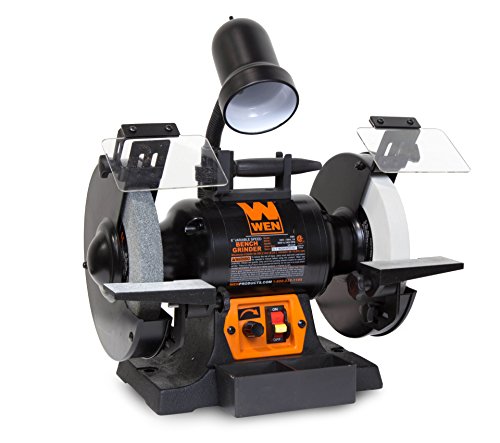
The BG4280 pairs an 8-inch wheel setup with a 5-amp motor and a variable speed range of 2,000 to 3,400 RPM. Dialing the speed down makes a genuine difference for sharpening work: slower wheel speeds remove metal more gradually and reduce the risk of drawing the temper out of a tool edge, while the top of the range still handles general grinding, deburring, and rust removal.
The flexible work light is the other practical feature here. Bench grinders often live in dim corners of a garage or basement, and a light you can aim directly at the wheel face makes it easier to see the bevel you are forming and to spot a nick before it becomes a bigger repair. Choose this model if one machine has to cover both ends of the job range — rough work at full speed and controlled sharpening at low speed — and if your bench lighting could use the help.
| Spec | Detail |
|---|---|
| Motor | 5-amp |
| Wheel size | 8 inch |
| Speed | Variable, 2,000 to 3,400 RPM |
| Work light | Flexible, adjustable |
WEN BG4286 3-Amp 8-Inch Low Speed Bench Grinder
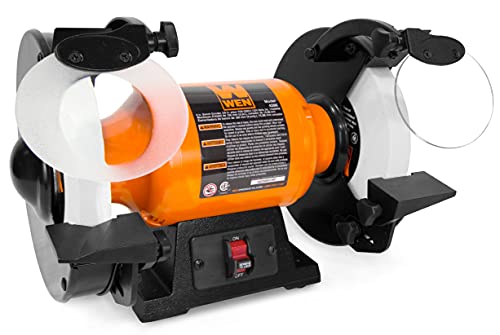
The BG4286 is the sharpening specialist of the group. Its 3-amp motor turns the wheels at a fixed slow speed of 1,750 RPM, roughly half the speed of a standard grinder. That slower pace is exactly what woodworkers want for chisels, plane irons, turning tools, and lathe tools, because the edge stays cooler and you get more control over how much steel comes off with each pass.
It arrives ready for sharpening work, with 60-grit and 120-grit aluminum-oxide wheels in the 8 by 1 inch size on a 5/8-inch arbor. The coarser wheel restores a damaged or badly dulled edge, and the finer wheel refines it before honing. The trade-off is speed on rough jobs: reshaping thick steel or grinding a mower blade takes noticeably longer at 1,750 RPM. Pick this grinder when edge tools are the priority and rough grinding is occasional rather than daily.
| Spec | Detail |
|---|---|
| Motor | 3-amp |
| Wheel size | 8 inch |
| Speed | 1,750 RPM, single speed |
| Included wheels | 60-grit and 120-grit aluminum oxide, 8 x 1 inch |
| Arbor | 5/8 inch |
Delta Power Tools 23-196 6-Inch Variable Speed Bench Grinder
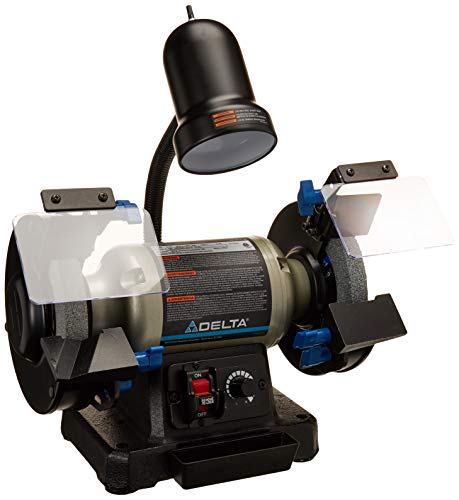
The Delta 23-196 brings variable speed to the smaller 6-inch format. Its 2.5-amp induction motor adjusts from 2,000 to 3,400 RPM, so it can slow down for sharpening drill bits, scissors, and kitchen or garden edges, then speed up again for cleaning bolts, removing burrs, and light shaping work.
The 6-inch wheels measure 6 inches across by 3/4 inch wide, and the whole machine takes up less bench depth than the 8-inch models above — a real consideration in a small workshop where the grinder shares space with everything else. Smaller wheels also wear toward their minimum diameter sooner and give you less working face, so heavy users will outgrow it faster. For a compact bench that still needs speed control, though, this is the balanced pick in the group.
| Spec | Detail |
|---|---|
| Motor | 2.5-amp induction |
| Wheel size | 6 inch x 3/4 inch |
| Speed | Variable, 2,000 to 3,400 RPM |
WEN BG4276 2.1-Amp 6-Inch Single Speed Bench Grinder with Flexible Work Light
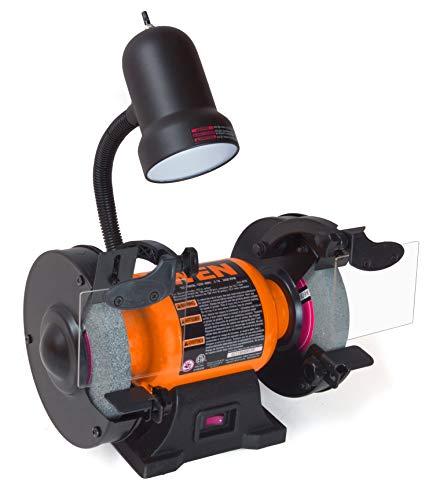
The BG4276 is the light-duty, small-footprint option. A 2.1-amp motor drives its 6-inch wheels at a single speed of 3,450 RPM, and at 16 pounds it is easy to move on and off the bench or store on a shelf between jobs — a sensible pattern for occasional sharpening and touch-up work rather than daily grinding.
It comes with 36-grit and 60-grit wheels in the 6 by 3/4 inch size on a 1/2-inch arbor, covering basic edge restoration and general cleanup. The flexible work light helps at the wheel face, though note that the bulb is not included; the light takes a 120V 40W R20 bulb. A 2-year warranty backs the machine. Choose it for a garage corner or hobby bench where the grinder handles screwdrivers, drill bits, pruners, and the odd mower blade a few times a season.
| Spec | Detail |
|---|---|
| Motor | 2.1-amp |
| Wheel size | 6 inch x 3/4 inch |
| Speed | 3,450 RPM, single speed |
| Included wheels | 36-grit and 60-grit |
| Arbor | 1/2 inch |
| Weight | 16 lb |
| Work light | Flexible; bulb not included (120V 40W R20) |
| Warranty | 2-year |
How to choose
Start with wheel size. Eight-inch wheels offer a larger working surface, last longer before wearing down, and suit longer tools; 6-inch wheels cost the machine less bench space and are easier to store. Next, think about speed. A fixed high speed near 3,450 to 3,600 RPM removes metal fast but overheats thin edges quickly. A slow speed around 1,750 RPM, or a variable range that reaches down near 2,000 RPM, is kinder to chisels, plane irons, and turning tools.
Match the wheels to the work as well. Coarse grits in the 36 to 60 range reshape and repair; finer grits around 120 refine an edge before honing. Check the arbor size before ordering replacement wheels — the picks above use both 5/8-inch and 1/2-inch arbors, and wheels are not interchangeable between them.
Safety deserves its own emphasis because grinding wheels spin fast and throw sparks. Wear eye protection every time — a face shield over safety glasses is better still — and keep loose clothing, jewelry, and long hair away from the wheels. Inspect each wheel before use: look for cracks or chips, and replace any wheel that is damaged or worn unevenly. Let a newly mounted wheel run for a minute while you stand to the side before putting work to it, and never grind on the side of a wheel that is not rated for side grinding.
Who should skip
Skip a bench grinder entirely if your only sharpening jobs are kitchen knives you prefer to hone by hand or with a guided sharpener — a grinder is easy to misuse on thin blades. Skip the high-speed single-speed models if your main work is fine woodworking edges; a slow or variable speed machine will serve you better. Skip the compact 6-inch picks if you regularly reshape thick steel or grind long tools, since the smaller wheels and tighter clearance will frustrate you. And skip grinding altogether on any tool you cannot afford to damage while learning — practice on scrap steel and old hardware first.
FAQ
Is a slow-speed grinder better for sharpening?
For edge tools, usually yes. A wheel turning at about 1,750 RPM removes metal gradually and builds less heat, which protects the temper of chisels, plane irons, and turning tools. High-speed grinders still work for sharpening, but they demand a lighter touch and frequent cooling of the edge in water.
What is the difference between 6-inch and 8-inch bench grinders?
Eight-inch grinders have larger wheels with more working surface, more clearance for long tools, and wheels that last longer before wearing down. Six-inch grinders are smaller, lighter, and easier to store, which suits occasional use and tight benches. Both handle typical home sharpening and cleanup jobs.
How do I check a grinding wheel before using it?
Unplug the grinder and inspect the wheel closely for cracks, chips, and uneven wear, and confirm the guards and tool rests are secure and adjusted. Many manufacturers recommend a ring test on vitrified wheels: suspend the wheel and tap it lightly — a clear ring suggests it is sound, while a dull thud can indicate a crack. Always follow the wheel and grinder manufacturers’ instructions, and replace any wheel you are unsure about.
Can a bench grinder sharpen lawn mower blades?
Yes, and it is one of the most common home uses. A coarse wheel at standard speed restores a mower blade’s edge quickly. Keep the blade’s original bevel angle, take light passes to avoid overheating the steel, and check the blade’s balance afterward so the mower runs smoothly.
Final verdict
Match the grinder to the work you actually do. The DEWALT DW758 is the pick for frequent, heavier grinding on a dedicated bench. The WEN BG4280 covers the widest range in one machine thanks to its variable speed and work light. The WEN BG4286 is the sharpening-first choice for woodworkers. The Delta 23-196 gives smaller benches real speed control, and the WEN BG4276 handles light, occasional tool care in the least space. Whichever you choose, eye protection, a pre-use wheel inspection, and the manufacturer’s instructions are part of the purchase.