Key takeaways
- Compare the best bench vises for home workshops and garages, covering jaw width, jaw opening, throat depth, swivel bases, pipe jaws and iron grades.
The best bench vise for most home workshops is a 5- or 6-inch swivel-base model in ductile or gray cast iron, with replaceable steel jaws, a jaw opening of at least 4 inches, and a throat depth near 3 inches. The Wilton WVA6 leads this roundup for its 8,300 pounds of clamping force and lifetime warranty, the Yost 750-DI is the most versatile pick thanks to its rotating head and three jaw sets, and the Yost LV-4 covers light home duty on a budget tier. Below, each vise is compared on the numbers makers publish: jaw width, jaw opening, throat depth, iron grade, pipe jaw capacity, base style and weight, so you can match the tool to your bench and your work.
As an Amazon Associate, we earn from qualifying purchases.
Table of Contents
- How to Choose a Bench Vise
- 1. Wilton 6-Inch Apprentice Bench Vise (WVA6)
- 2. Yost 750-DI Multi-Jaw Rotating Vise
- 3. Forward DT08125A 5-Inch Bench Vise
- 4. Wilton General Purpose Bench Vise (11104)
- 5. Yost LV-4 Home Vise
- Frequently Asked Questions
- Conclusion
- Product and ASIN Reference
How to Choose a Bench Vise
Jaw width is the figure in the model name, and it sets how much contact the jaws make with a workpiece. Four-inch vises suit bicycle work, small engine parts and household repair. Five- and six-inch vises are the all-round sizes most shop owners settle on, because the wider face spreads clamping pressure and holds bar, tube and lumber with less rocking.
Jaw opening is how far the jaws separate, and it can be smaller than the jaw width on compact models. A vise that opens 3 inches handles most hardware and small stock, while a 5- or 6-inch opening swallows thick blocks, wide fittings and stacked parts. Buy for the thickest piece you clamp often, not the thickest piece you can imagine.
Throat depth measures from the top of the jaws down to the slide. It limits how tall a part can sit in the jaws when held upright. Depths run from about 2-1/4 inches on compact vises to nearly 4 inches on rotating-head models, and the deeper figure matters for holding brackets, plates and pipe fittings on edge.
Iron grade decides how the body behaves under abuse. Gray cast iron, rated near 30,000 PSI in tensile strength, is stiff and economical but brittle, so a hard hammer blow on the wrong spot can crack it. Ductile iron, rated from 60,000 to 72,000 PSI on the models below, flexes slightly before it fails and shrugs off rough handling better. For holding, filing and sawing, either grade works. For heavy cranking and frequent hammer work nearby, ductile iron is the safer buy.
Swivel base and jaws round out the choice. A base that turns and locks at two points lets you angle work toward the light without unclamping. Pipe jaws below the main jaws grip round stock that flat jaws would spin, and replaceable jaw inserts mean a worn face can be swapped instead of replacing the whole vise. A small flat anvil behind the jaws is handy for light tapping and flattening, and no vise anvil is a substitute for a real anvil on heavy forging.
1. Wilton 6-Inch Apprentice Bench Vise (WVA6)
Tier: Premium
The Wilton WVA6 is the strongest vise in this roundup on paper, and it earns the top spot for shops that clamp hard every day. Its ductile iron body is rated at 72,000 PSI in tensile strength, roughly double the gray iron used in lighter vises, and the maker rates clamping force at 8,300 pounds, the highest figure here. Six-inch jaws open a full 6 inches, and the 3-3/4-inch throat depth is deep enough to hold tall brackets and fittings upright without the slide getting in the way.
Pipe jaws built into the body grip pipe from 1/4 inch to 3 inches, which covers household plumbing sizes and most conduit work. The base turns a full 360 degrees and bolts down through four mounting points, so the vise stays planted when you lean on the handle. At 25.7 pounds it is heavy enough to feel solid yet light enough to mount on an ordinary bench without reinforcement in most cases. Wilton backs the WVA6 with a lifetime warranty, the longest coverage in this group, and the enclosed body style helps keep filings and grit away from the screw. For a buy-once vise for a garage or fabrication bench, this is the pick.
Specs
- Model: WVA6 (stock number WL1-109)
- Jaw width: 6 inches
- Jaw opening: 6 inches
- Throat depth: 3-3/4 inches
- Jaw depth: 1-5/16 inches
- Clamping force: 8,300 pounds
- Body material: ductile iron, 72,000 PSI tensile strength
- Pipe jaw capacity: 1/4 inch to 3 inches
- Base: 360-degree swivel, 4 mounting points
- Net weight: 25.7 pounds
- Warranty: lifetime
2. Yost 750-DI Multi-Jaw Rotating Vise
Tier: Premium
The Yost 750-DI solves a different problem: one vise that handles flat stock, round pipe and odd shapes without a second tool on the bench. The head rotates a full 360 degrees and locks at every 30 degrees, giving twelve fixed positions, and it carries three sets of replaceable hardened steel jaws. The flat bench jaws handle bar and plate, the pipe jaws grip round stock from 5/8 inch to 3-1/2 inches, and the V-jaws cradle round bar and tube that would roll in flat jaws.
The body is cast from ductile iron rated at 65,000 PSI, and the maker’s manual lists a 5-inch jaw width, a 5-inch maximum opening and a throat depth of 3.87 inches, a deep figure that helps with tall parts. The base swivels on an interlocking V-groove with two lockdowns, so both the base and the head can be angled for welding, drilling and filing work. The trade-off is mass: at 56.8 pounds this vise needs a stout bench and through-bolts, and it is more tool than a small hobby bench requires. For plumbers, welders and fabricators who clamp pipe and flat stock in the same session, nothing else here matches its range.
Specs
- Model: 750-DI
- Jaw width: 5 inches
- Jaw opening: 5 inches
- Throat depth: 3.87 inches
- Pipe jaw capacity: 5/8 inch to 3-1/2 inches
- Body material: ductile iron, 65,000 PSI tensile strength
- Jaw sets: 3 sets of replaceable hardened steel jaws (flat, pipe and V-jaw)
- Head rotation: 360 degrees, locking detents every 30 degrees (12 positions)
- Base: swivel base with interlocking V-groove and two lockdowns
- Vise weight: 56.8 pounds
3. Forward DT08125A 5-Inch Bench Vise
Tier: Mid-range
The Forward DT08125A brings ductile iron construction and a rotating head to the mid-range tier. The body is high-strength ductile iron rated at 60,000 PSI, and Forward rates clamping force at 5,500 pounds or more, a strong figure for a 5-inch vise. Both the base and the head rotate 360 degrees, so work can be angled from two axes, a feature usually found on higher-tier models. Three jaw configurations cover flat stock, pipe and V-groove holding.
Published dimensions are a 5-inch jaw width, a 5-inch jaw opening and a 2.6-inch throat depth, with pipe jaw capacity from 0.6 inch to 2.5 inches. The anvil on the back of the head measures 3.2 by 2.6 inches, enough room for light flattening and tapping work. At 33 pounds the DT08125A is manageable to mount, and it bolts down through a three-hole swivel base with two lockdowns. Forward publishes a 10-year warranty for this model, well beyond the coverage on most mid-range vises. Mounting bolts are not included, so plan on hardware matched to your bench top thickness. For a home shop that wants ductile iron and a rotating head without moving to the premium tier, this is the balanced choice.
Specs
- Model: DT08125A
- Jaw width: 5 inches
- Jaw opening: 5 inches
- Throat depth: 2.6 inches
- Pipe jaw capacity: 0.6 inch to 2.5 inches
- Body material: ductile iron, 60,000 PSI tensile strength
- Clamping force: at least 5,500 pounds
- Base: 360-degree swivel base; head also rotates 360 degrees
- Anvil area: 3.2 x 2.6 inches
- Weight: 33 pounds
- Warranty: 10 years
4. Wilton General Purpose Bench Vise (11104)
Tier: Mid-range
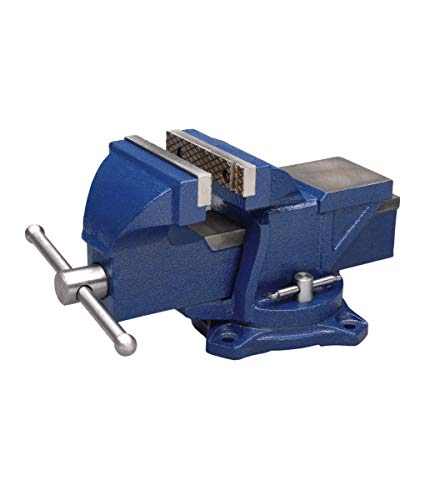
The Wilton 11104 is the classic home garage vise: compact, simple and built around a gray cast iron body rated at 30,000 PSI. Four-inch jaws open 3 inches, and the throat depth is 2-1/4 inches, figures that fit mower blades, bicycle parts, garden tools and small hardware rather than heavy fabrication stock. The jaw faces are replaceable hardened steel inserts with machine serrations, so a worn or damaged face can be unbolted and swapped, which extends the life of the tool well past that of fixed-jaw budget vises.
A flat anvil area behind the jaws handles light tapping, and the base swivels 120 degrees, enough to angle most work toward you without remounting. The 11104 has been in Wilton’s catalog for decades, and replacement jaw inserts remain easy to find, which matters for a tool that should serve for years. Wilton covers it with a lifetime warranty against defects. It will not match the ductile iron models above for brute strength, and the 3-inch opening rules out thick stock, but for a first vise on a household bench it covers the common jobs with room to spare.
Specs
- Model: 11104
- Jaw width: 4 inches
- Jaw opening: 3 inches
- Throat depth: 2-1/4 inches
- Body material: gray cast iron, 30,000 PSI tensile strength
- Jaws: replaceable hardened steel inserts, machine serrated
- Base: 120-degree swivel
- Anvil: built-in flat anvil area
- Warranty: lifetime
5. Yost LV-4 Home Vise
Tier: Budget
The Yost LV-4 is the budget anchor of this roundup and one of the most widely owned home vises sold. Its cast iron body is rated at 30,000 PSI, the jaws are 4.5 inches wide and open 3 inches, and the throat depth is 2.6 inches, slightly deeper than the Wilton 11104 above. Built-in pipe jaws below the main jaws hold pipe and tube from 0.6 inch to 1.85 inches in diameter, which makes the LV-4 handy for light plumbing work as well as flat stock.
The base swivels 240 degrees and locks down, and it mounts through four holes in the base flange. Yost recommends 3/8-inch bolts for mounting, and the bolts are sold separately, so add hardware to the shopping list. The steel jaw faces can be removed and fitted with shop-made pads of wood or softer metal when a workpiece needs protection from the serrations. The blue powder coat finish resists shop grime, and the zinc-plated main screw turns smoothly for a vise in this tier. The limits are honest ones: the screw is exposed to dirt, so it needs a wipe and a drop of oil now and then, and gray iron asks for restraint with a hammer. For occasional clamping, sharpening and repair work, it does the job at the lowest tier here.
Specs
- Model: LV-4
- Jaw width: 4.5 inches
- Jaw opening: 3 inches
- Throat depth: 2.6 inches
- Body material: cast iron, 30,000 PSI tensile strength
- Pipe jaw capacity: 0.6 inch to 1.85 inches
- Base: 240-degree swivel, 4 mounting holes
- Jaws: steel jaw faces, removable for shop-made pads
- Finish: blue powder coat
- Mounting hardware: not included (maker recommends 3/8-inch bolts)
Frequently Asked Questions
What size bench vise is best for a home workshop?
A 5- or 6-inch vise suits most home workshops. That size pairs a wide gripping face with an opening of 5 to 6 inches, enough for lumber, bar stock, fittings and small assemblies. A 4- or 4.5-inch vise is fine for light repair and hobby work, while rotating-head models in the 5-inch class add pipe and V-jaws for plumbing and fabrication tasks.
What is the difference between gray iron and ductile iron vises?
Gray cast iron is rated near 30,000 PSI in tensile strength. It is stiff and economical, but brittle, so a hard blow can crack a jaw or flange. Ductile iron is rated from 60,000 to 72,000 PSI on the vises in this guide and flexes slightly before it fails, which makes it more forgiving of heavy cranking and rough handling. For holding and filing, both work well. For daily hard use, ductile iron is the safer material.
Do I need pipe jaws on a bench vise?
Pipe jaws help whenever round stock is part of the work. Flat jaws touch a pipe at two narrow points, so the piece can spin under a wrench or saw. Pipe jaws cradle the curve and spread the grip, holding tube and fittings steady for cutting and threading. Models here grip pipe from as small as 1/4 inch to as large as 3-1/2 inches, so check the published capacity against the pipe sizes on your bench.
How should a bench vise be mounted to a workbench?
Bolt the vise through the bench top with bolts, washers and nuts rather than lag screws, and place it near a corner so long work can hang past the edge of the bench. Use every mounting hole in the base, snug the hardware evenly, and confirm the swivel lock holds before the first job. A light vise on a light table will walk under load, so a heavy, rigid bench improves any vise on this list.
Conclusion
For most buyers, the Wilton WVA6 is the bench vise to get: ductile iron at 72,000 PSI, 8,300 pounds of clamping force, a 6-inch opening and a lifetime warranty. The Yost 750-DI is the better pick when pipe, round bar and angled work are part of the routine, thanks to its rotating head and three jaw sets. The Forward DT08125A splits the difference with ductile iron and a rotating head on the mid-range tier, the Wilton 11104 remains a dependable compact vise for household repair, and the Yost LV-4 covers light duty at the budget tier. Match jaw opening and throat depth to the work you clamp most, bolt the vise down properly, and any of these five will hold work steady for years.