Key takeaways
- Compare five small-shop dust collectors and learn how CFM, static pressure, cyclone design, filtration level and bag capacity affect your pick.
A small workshop produces more dust, and finer dust, than a shop vacuum was built to handle. Table saws, planers and jointers throw off a steady stream of chips and airborne particles, and a dedicated dust collector moves far more air than a vacuum, capturing debris at the tool instead of letting it settle everywhere. The catch is that listings lead with big airflow numbers that do not tell the whole story.
Choosing well comes down to four things: how much air the unit moves against resistance, whether it separates chips in a single stage or two, how fine its filter media is, and how much debris it holds before emptying. The five collectors below span that range, from compact rolling bag units to a larger canister-filter model and a two-stage cyclone.
As an Amazon Associate, we earn from qualifying purchases.
Quick answer
Start with airflow: a small shop running one machine at a time needs roughly 500 to 700 CFM at the tool, and filtration matters as much as suction. A 5-micron bag suits chip-heavy work, while a 1-micron bag or canister traps finer dust. Choose single-stage for simplicity, or a two-stage cyclone if filter clogging frustrates you.
WEN DC3401: The Compact Brushed-Motor Starting Point
The DC3401 is the smallest and lightest collector here, built around a 5.7-amp brushed motor. WEN sells this unit by amps rather than horsepower and rates it at 660 CFM, with a single 4-inch dust port and a 6-inch impeller. A 12-gallon bag collects the debris, filtered by a 5-micron zippered bag that suits chip-heavy tools like a planer or jointer.
Mobility is its strongest suit: a mobile base with lockable swivel casters, under 20 lb, and an optional wall mount. For a garage shop where the collector rolls to each machine, that footprint is hard to beat. The trade-offs are the simpler brushed motor and the smaller bag, which fills faster under a planer. A two-year warranty backs the unit.
| Specification | Detail |
|---|---|
| Motor | 5.7-amp brushed |
| Airflow | 660 CFM (maker’s rating) |
| Filtration | 5-micron zippered bag |
| Collection bag | 12 gallons |
| ASIN | B09Q7F9NC8 |


WEN DC3474: The Induction-Motor Step Up
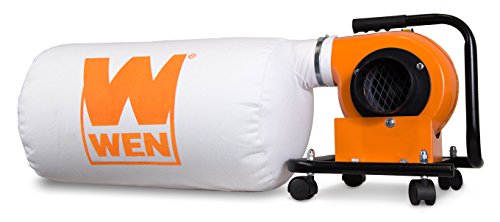
The DC3474 keeps the same rolling format but swaps in a 7.4-amp induction motor, a quieter, maintenance-free design compared with brushed motors. It carries a larger 9-inch impeller and a 15-gallon bag, still with 5-micron filtration and a single 4-inch dust port.
One figure deserves a second look: WEN rates the DC3474 at up to 600 CFM, lower on paper than the DC3401’s 660 CFM despite the bigger motor. That is not a misprint: headline CFM figures are maker ratings from each brand’s own test conditions, not a universal score. The step up buys the induction motor, larger bag, and bigger impeller. Four 2-inch swivel casters and a handle keep it portable at 41.1 lb, the wheels come off for the wall mount, and a two-year warranty applies.
| Specification | Detail |
|---|---|
| Motor | 7.4-amp induction |
| Airflow | Up to 600 CFM (maker’s rating) |
| Filtration | 5-micron zippered bag |
| Collection bag | 15 gallons |
| ASIN | B09T4XLXFY |
POWERTEC DC5372: Finer Filtration in a Portable Frame
The DC5372 is the pick for buyers who care most about filtration at this size. Its filter bag is rated at 1 micron, noticeably finer than the 5-micron bags on the WEN units, and the 14 x 24 in bag adds a dust-level window and a bottom zipper for cleaner emptying. Airflow is rated at 560 CFM through a 4-inch intake.
The motor is a 1 HP single-phase unit running on 120V or 240V, drawing 12 amps at 120V or 6 amps at 240V, handy with a 240V circuit. Note the frame: this is the portable version on casters, not a wall-mount unit, at 43.6 lb. POWERTEC states no bag capacity in gallons and publishes no noise rating, so judge it on filtration and the dual-voltage motor.
| Specification | Detail |
|---|---|
| Motor | 1 HP, 120V/240V, 60 Hz, single-phase |
| Current draw | 12 A at 120V, 6 A at 240V |
| Airflow | 560 CFM |
| Filtration | 1-micron bag, 14 x 24 in, window, zipper |
| ASIN | B0BXCDQPLW |
JET DC-1100VX-CK: The Canister-Filter Floor Unit
The JET is the step-up end of this small-shop class: a floor-standing unit on four casters, weighing 159 lb, with a 1-1/2 HP motor wired for 115/230V single-phase and prewired at 115V. It filters through a 2-micron canister instead of a bag, and its Vortex Cone improves chip separation so the canister clogs more slowly. Collection capacity is 5.3 cubic feet in snap-ring bags, five included.
JET quotes this collector at 1,100 CFM with filters installed, and that basis matters. Most makers publish a free-air figure with nothing attached, so a with-filters rating is not interchangeable with the smaller units’ headline figures. JET also publishes an 80 dB sound rating, the only stated noise figure here, and a five-year warranty (two years commercial). Amps and inlet size were not stated in the listing information reviewed, so confirm those before ordering.
| Specification | Detail |
|---|---|
| Motor | 1-1/2 HP, 115/230V single-phase, prewired 115V |
| Airflow | 1,100 CFM with filters installed |
| Filtration | 2-micron canister filter, Vortex Cone |
| Noise rating | 80 dB |
| ASIN | B004T86NAK |
Grizzly G0860: The Two-Stage Cyclone Step Up
The G0860 is different in kind from the other four: a two-stage cyclone. Incoming air spins in the cyclone body first, so chips and heavier debris drop into a 20-gallon drum before the air reaches the 1-micron canister filter. Because the cyclone does the heavy separation, the canister loads slowly, and emptying the drum never disturbs the filter.
The motor is 1.5 HP on 110V single-phase. Grizzly quotes airflow at 868 CFM at 1.8 in. of static pressure, maximum 9.7 in. That figure is stated against a defined resistance, not as a free-air maximum, so do not compare it head-to-head with the bag units’ headline CFM numbers. The inlet is a 6-inch main adapting to two 4-inch inlets, it is rated for two machines at a time, and a remote control is included. Amps and noise were not confirmed in the sources reviewed, so neither appears here.
| Specification | Detail |
|---|---|
| Motor | 1.5 HP, 110V, single-phase |
| Airflow | 868 CFM at 1.8 in. static pressure |
| Filtration | 1-micron canister filter |
| Collection drum | 20 gallons |
| ASIN | B07K1YTJZD |
How to choose
CFM versus static pressure
CFM, cubic feet per minute, describes how much air a collector moves; static pressure describes how hard it can pull against resistance. Every foot of hose, elbow, and loading filter adds resistance, so delivered airflow is always lower than the number on the box. Makers measure differently, too: most publish a free-air maximum, JET quotes with filters installed, and Grizzly quotes at a stated static pressure. Treat headline CFM as a rough size class, not a ranking.
Single-stage versus two-stage cyclone
In a single-stage collector, everything the hose picks up passes through the impeller and lands in one bag, and the bag is also the filter: the simplest, most compact arrangement, used by the two WEN units and the POWERTEC. In a two-stage cyclone like the Grizzly, a cyclone body separates chips and most dust into a drum before the air reaches the filter, so the filter stays cleaner and the drum empties without opening the filter side. The cost is a bigger, more complex machine.
Filtration level
The micron rating tells you the smallest particle size the filter media is designed to catch. A 5-micron bag, as on the WEN pair, handles chips and coarse dust well and is the economical choice. A 1-micron bag or canister, as on the POWERTEC, JET, and Grizzly, traps much of the finer fraction that stays airborne longest. Canisters also pack a large pleated surface into a compact housing, which helps airflow hold up as the filter loads. If your work is mostly sanding, prioritize finer filtration over a small CFM advantage.
Bag and canister capacity
Capacity decides how often you stop work to empty the machine. The DC3401’s 12-gallon bag suits a hobby shop running one tool at a time; the DC3474 stretches that to 15 gallons; the Grizzly’s 20-gallon drum and the JET’s 5.3 cubic feet suit shops that mill a lot of stock. A dust-level window, bottom zipper, or separate drum also makes emptying cleaner. Match capacity to your biggest dust producer, usually the planer.
Who should skip
Skip a dedicated collector if your shop runs only one small benchtop tool now and then; a shop vacuum covers that duty. Skip the compact rolling units if you are planning fixed duct runs to several machines at once, a job for a larger stationary collector class. Skip the JET and the Grizzly if floor space is tight; both are floor-standing machines that earn their keep only when parked permanently. And skip any collector whose inlet, voltage, or circuit draw you cannot match to your shop.
FAQ
How much CFM does a small workshop actually need?
For one machine running at a time, a collector in the 500 to 700 CFM class covers most table saws, jointers, and planers in a home shop. Delivered airflow at the tool is what matters; design, hose length, and filter condition move real performance more than small rating differences.
Why do similar CFM ratings perform differently?
Makers measure differently: some publish a free-air maximum, JET quotes with filters installed, and Grizzly quotes at a stated static pressure. A rating given against resistance describes a working setup more honestly, so compare the basis, not just the number.
Is a 1-micron filter worth choosing over a 5-micron bag?
If you sand often or work in an enclosed space, yes. A 5-micron bag captures chips and coarse dust, while a 1-micron bag or canister traps much of the fine fraction still airborne. For mostly rough milling, a 5-micron bag remains a sensible, economical pick.
Can one dust collector serve two machines at the same time?
Only the Grizzly G0860 here is rated for that, with its 6-inch main inlet and adapter to two 4-inch inlets. The single-inlet bag units are one-machine-at-a-time designs; moving the hose between tools is the pattern for them.
Final verdict
Match the design to your shop’s bottleneck. If space and simplicity rule, the WEN DC3401 covers one machine at a time in the smallest footprint, and the DC3474 adds an induction motor and a bigger bag in the same format. If fine dust is the main concern, the POWERTEC DC5372 pairs 1-micron filtration with a dual-voltage motor. If the collector will run daily and stay put, the JET DC-1100VX-CK offers canister filtration and the largest bag capacity here, while the Grizzly G0860 is the step up to two-stage separation. Choose on filtration and separation design first, capacity second, headline CFM last.