Key takeaways
- Compare the best cable cutters for copper, aluminum and steel wire rope, with ratcheting and shear picks matched to cutting capacity and cable size.
- Top Pick: Klein Tools 63060 Ratcheting Cable Cutter
- Runner-up: Southwire CCPR400 Ratcheting Cable Cutter
- Also consider: KNIPEX 95 11 165 Cable Shears
The best cable cutter for most electrical work is a shear-type or ratcheting cutter sized to the largest cable you cut regularly: the Klein Tools 63060 ratcheting cutter covers feeder cable up to 600 MCM copper and 750 MCM aluminum, while the compact KNIPEX 95 11 165 shears handle everyday copper and aluminum up to 1/0 AWG in a pouch-sized tool. Match the cutter to the cable material first, because a cutter built for soft copper and aluminum will be damaged by steel wire rope, and a wire rope cutter is the wrong tool for large feeder cable.
This guide compares five cable cutters across the three designs that matter: high-leverage shears for service and branch work, ratcheting cutters for large feeder cable, and a dedicated wire rope cutter for steel cable. Each pick is rated from its published cutting capacity, length, and blade material, so you can line the tool up against the cable on your truck or in your shop.
As an Amazon Associate, we earn from qualifying purchases.
Table of Contents
- How to Choose a Cable Cutter
-
- Klein Tools 63060 Ratcheting Cable Cutter
-
- Southwire CCPR400 Ratcheting Cable Cutter
-
- KNIPEX 95 11 165 Cable Shears
-
- WORKPRO 9-1/4 Inch High-Leverage Cable Cutter
-
- Muzata M015 Wire Rope Cable Cutter
- Care and Safety Basics
- Frequently Asked Questions
- Conclusion
- Product and ASIN Reference
How to Choose a Cable Cutter
Begin with the cable material. Most hand cable cutters are built for copper and aluminum conductors only. Their shear blades are ground to slice soft metal cleanly, and the makers state plainly that steel cable, ACSR, and hard-drawn copper are out of bounds. Steel wire rope needs a cutter with hardened, notched jaws made for steel, such as the Muzata pick below. Using a copper cutter on steel rope is the fastest way to chip or roll a blade edge.
Read the capacity rating, not the tool size. Capacity is published two ways. Smaller cutters are rated in AWG, such as 2/0 or 4/0, while large ratcheting cutters are rated in MCM (also written as kcmil), such as 600 MCM or 750 MCM. Communications cable is often rated by pair count, such as 100-pair 24 AWG. Buy for the largest cable you cut often, and treat the printed maximum as a ceiling for occasional cuts rather than an all-day working size.
Pick the mechanism for the work. High-leverage shears cut in one squeeze and are the quickest option for repeated cuts on branch and service cable. Ratcheting cutters trade speed for force: each squeeze advances the blade a small step, so one person can cut feeder cable that no hand shear could handle. Two-step ratchet designs, used by both ratcheting picks in this guide, take fewer strokes per cut than single-step designs. A quick-release lever matters on a ratcheting tool because it lets you open the blade mid-cut to reposition or remove the cable.
Check blade construction. Through-hardened or fully hardened blades hold an edge longer than surface-hardened blades, and replaceable blades, offered on the Southwire CCPR400, extend the working life of the tool. Chrome vanadium steel is the common blade material in the budget tier and performs well within its rated capacity.
Mind length and weight. A 6.5 inch shear rides in a pouch and works one-handed in panels and boxes. A 9 to 10 inch cutter needs two hands on larger cable but delivers the leverage for 4/0 aluminum. Ratcheting cutters are the heaviest option here, which is a fair trade when the alternative is a long-handle cutter that will not fit in the space.
1. Klein Tools 63060 Ratcheting Cable Cutter
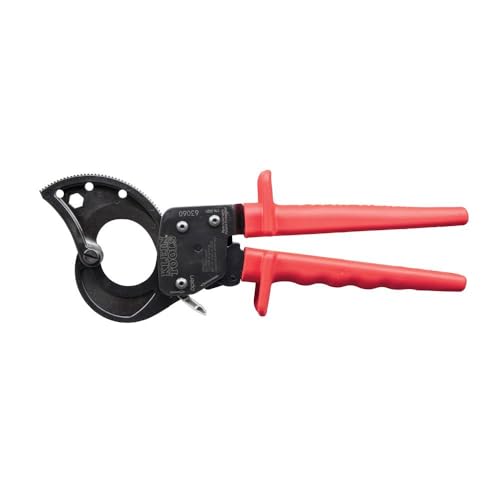
The Klein Tools 63060 is the premium pick for large feeder work. Its published capacity reaches 600 MCM copper and 750 MCM aluminum, which covers the service and feeder sizes most commercial and industrial electricians meet, and the high-leverage ratchet mechanism is built for single-handed cutting that leaves no burrs or sharp edges on the conductor.
The patented two-step ratchet mechanism requires fewer strokes per cut than a single-step ratchet, which adds up over a day of cable preparation. A quick-release lever opens the blades at any point in the cut, and a hold-open spring keeps the jaw ready for rapid repeat cuts. The blades are hardened steel. For crews who cut large copper and aluminum daily and want the ratchet to do the heavy work, this is the cutter to build the kit around.
Specs
- Type: Ratcheting cable cutter
- Cutting capacity: 600 MCM copper, 750 MCM aluminum
- Mechanism: Two-step ratchet with quick-release lever and hold-open spring
- Blade material: Hardened steel
- Country of origin: Made in Germany
2. Southwire CCPR400 Ratcheting Cable Cutter

The Southwire CCPR400 posts the largest capacity in this guide: up to 750 kcmil copper and 1000 kcmil aluminum on single conductors. That headroom puts it in the mid-range tier while covering cable sizes that usually demand a much larger tool, and the compact 10.25 inch frame still fits in a tool bag.
Its hardened steel blades are replaceable, which separates it from most ratcheting cutters at this level, and the rounded blade profile is designed to minimize cable distortion during the cut. The two-step ratcheting mechanism reduces strokes per cut, a quick-release lever opens the blade at any time, and molded grips round out the handling. Note the published limit: the maximum capacity applies to single-conductor cable, and the tool is not made for steel or ACSR.
Specs
- Type: Ratcheting cable cutter
- Cutting capacity: 750 kcmil copper, 1000 kcmil aluminum, single conductor
- Blade material: Replaceable hardened steel
- Mechanism: Two-step ratcheting with quick-release lever
- Dimensions: 10.25 x 5.5 x 1.25 inches
- Weight: 31 ounces
- Handles: Molded grips
3. KNIPEX 95 11 165 Cable Shears

The KNIPEX 95 11 165 is the compact precision option. At 6.5 inches long and under 8 ounces, it is a true one-hand pouch tool, and its precision-ground, hardened blades shear copper and aluminum cable up to 15 mm diameter, which the maker also rates as 50 square millimeters or 1/0 AWG.
The shear geometry is the point of this tool: the blades are ground to cut stranded conductors cleanly without crushing the cable out of round, which keeps lugs and terminals seating properly. Plastic-dipped handles keep the profile slim. The published limits are firm ones, since KNIPEX states the shears are not suitable for steel wire or hard-drawn copper conductors. Within copper and aluminum branch work, this is the premium compact pick.
Specs
- Type: Cable shears, single jaw
- Length: 6.5 inches (165 mm)
- Cutting capacity: Copper and aluminum cable up to 15 mm diameter, 50 square millimeters (1/0 AWG)
- Blade material: Precision-ground hardened steel
- Handles: Plastic dipped
- Weight: 7.8 ounces
- Not rated for: Steel wire or hard-drawn copper
4. WORKPRO 9-1/4 Inch High-Leverage Cable Cutter
The WORKPRO W015067A covers the same everyday envelope as the classic electrician shears: 4/0 aluminum, 2/0 soft copper, and 100-pair 24 AWG communications cable, in a 9.25 inch high-leverage frame. That makes it the budget pick for service work, panel work, and battery cable in the sizes most often cut outside of feeder runs.
The blades are chrome vanadium steel, and the long handles supply the leverage for one clean squeeze on cable at the top of its range. As with every shear cutter in this class, the rating covers copper, aluminum, and communications cable only, and the maker states it is not suitable for cutting steel. For a first dedicated cable cutter, or a spare that lives in a second bag, this is the sensible spend.
Specs
- Type: High-leverage cable cutter
- Model: W015067A
- Length: 9.25 inches
- Cutting capacity: 4/0 aluminum, 2/0 soft copper, 100-pair 24 AWG communications cable
- Blade material: Chrome vanadium steel
- Not rated for: Steel cable
5. Muzata M015 Wire Rope Cable Cutter

The Muzata M015 is the steel specialist of the group. Where the other four cutters are copper and aluminum tools, this one is built for steel wire rope up to 5/32 inch (4 mm), the size range used in deck cable railing, aircraft cable, and bicycle brake and shift housing.
The blade is chrome vanadium steel, and the compact body weighs 10.5 ounces, light enough for ladder work on railing installs. It is a one-trick tool by design: it will not touch feeder cable, and the copper cutters above will not survive steel rope, so many kits carry one of each. For railing contractors and anyone rigging light steel cable, this is the budget pick that matches the material.
Specs
- Type: Wire rope cutter
- Model: M015 (part MZZ1616)
- Cutting capacity: Steel wire rope up to 5/32 inch (4 mm)
- Blade material: Chrome vanadium steel
- Weight: 10.5 ounces
- Typical uses: Cable railing, aircraft cable, bicycle cable housing
Care and Safety Basics
Keep the blade matched to the material. Every cutter in this guide carries a published material limit, and cutting steel, ACSR, or armored cable with a copper and aluminum tool damages the edge and can crack a jaw. Cut only de-energized cable, and treat every conductor as live until you have confirmed otherwise with your normal lockout routine.
Wipe blades clean after use and store the tool dry; black oxide and coated finishes slow corrosion but do not stop it. On ratcheting cutters, keep the mechanism free of grit so the pawl engages cleanly, and use the quick-release lever rather than forcing the handles backward when a cut needs to be abandoned. When a blade finally dulls, a replaceable-blade design such as the Southwire CCPR400 goes back to work with a blade swap instead of a full tool replacement.
Frequently Asked Questions
What size cable cutter do I need for 4/0 aluminum cable?
Any cutter in this guide rated at 4/0 aluminum or above will handle it, including the WORKPRO high-leverage cutter at the budget tier. For repeated daily cuts at that size, a ratcheting cutter such as the Klein Tools 63060 or the Southwire CCPR400 reduces hand effort, since each squeeze advances the blade in small steps instead of one full-force squeeze.
Can a cable cutter cut steel wire rope?
Only a cutter built and rated for steel can. The copper and aluminum shears and ratcheting cutters in this guide state that steel is out of bounds, and forcing them through wire rope can chip the blades. The Muzata M015 is the steel-rated pick here, covering wire rope up to 5/32 inch (4 mm).
What is the difference between a ratcheting cutter and a shear cutter?
A shear cutter closes its blades in a single squeeze, so it is fast on cable within hand strength, up to roughly 4/0 aluminum in a 9 inch tool. A ratcheting cutter advances the blade a step at a time over several squeezes, trading speed for the force needed to cut feeder cable rated in MCM sizes. Choose shears for branch and service work, and a ratchet for large feeders.
Can cable cutters cut ACSR or armored cable?
No. None of the five cutters in this guide is rated for ACSR, which has a steel core, or for steel-armored cable. Those materials need a cutter whose published rating names ACSR or steel, and using a copper and aluminum cutter on them risks blade damage and a poor cut.
Conclusion
Match the cutter to the cable and the choice makes itself. The Klein Tools 63060 is the premium ratcheting pick for feeder work up to 600 MCM copper, the Southwire CCPR400 answers with the largest capacity here and replaceable blades in the mid-range tier, and the KNIPEX 95 11 165 is the compact premium shear for clean one-hand cuts up to 1/0 AWG. The WORKPRO covers the everyday 4/0 aluminum and 2/0 copper envelope on a budget, and the Muzata M015 handles the steel wire rope that the other four must never touch.