Key takeaways
- Five bench stones for chisels and plane irons compared by grit stage, stone width and lubricant, from a coarse diamond plate to a fine Arkansas tri-hone.
- Top Pick: Shapton K0702 #1000 Medium Waterstone
- Runner-up: DMT D8C Dia-Sharp Coarse Diamond Plate
- Also consider: Norton 4000/8000 Combination Waterstone
A chisel or plane iron is only as good as the stone that maintains it: dull edges tear wood fibers instead of slicing them, and a nicked bevel leaves tracks no amount of sanding fully hides. The right bench stone depends on three things: which sharpening stage the edge needs, whether the stone is wide enough for the iron, and which lubricant system it belongs to.
This guide compares five stones and plates covering the full progression, from repairing a damaged bevel to polishing a finished edge, each matched to the job it does best. Grit figures are always given as the maker’s own figures, because grit numbers are not comparable across brands.
As an Amazon Associate, we earn from qualifying purchases.
Quick answer
Start with a stone that covers the stages your edges actually need. The King KW65 1000/6000 sharpens and hones in one stone, the DMT D8C plate repairs nicks and flattens backs, and the Norton 4000/8000 only polishes. Match stone width to your widest iron, and never mix oil and water systems.
KING KW65 1000/6000 Combination Whetstone
The King KW65 is the default first stone for a woodworking bench. It is a combination waterstone from King (Matsunaga) of Japan, with two bonded faces, a 1000 face for sharpening and a 6000 face for honing, both King’s own grit figures. One stone therefore covers the two middle stages of the progression, where most routine maintenance happens.
The stone measures 8 x 2 x 1 in and comes with a plastic base. At 2 in wide it is at least as wide as a standard 2-inch plane iron, though with no overhang margin to spare. Soak it before use, keep it wet while sharpening, and never use oil on it, because oil clogs the surface and ruins the slurry action. As the softest stone here, it dishes fastest and needs flattening most often.
| Brand | Product | ASIN | Key specs |
|---|---|---|---|
| King | KW65 1000/6000 | Combination waterstone, 1000 and 6000 grit (King figures), 8 x 2 x 1 in, plastic base included, water only |
Shapton K0702 #1000 Medium Waterstone
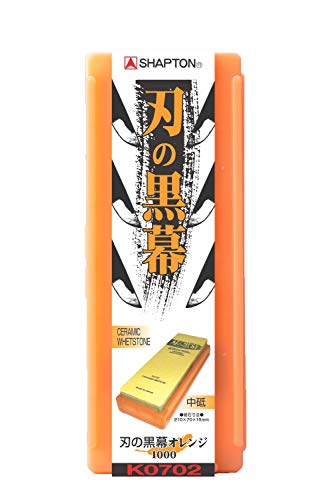
The Shapton K0702 is the step up from a soft soaking combination stone. It is a hard synthetic ceramic waterstone from Shapton’s Pro series, also sold as the Ha No Kuromaku line: orange, made in Japan, in a single #1000 grit, Shapton’s own figure. A single medium grit makes it a dedicated sharpening stone, meant to pair with a finer stone for honing.
The stone measures 210 x 70 x 15 mm, roughly 8.3 x 2.8 x 0.6 in, so it covers a 2-inch plane iron comfortably. It ships in a storage case that doubles as a stone holder during use. Unlike the King, the Kuromaku line is splash-and-go: wet the surface and start, with no soaking. Its hard ceramic bond dishes slowly, so it stays flat longer between flattening sessions. Use water only, never oil.
| Brand | Product | ASIN | Key specs |
|---|---|---|---|
| Shapton | K0702 #1000 | B001TPFT0G | Synthetic ceramic waterstone, single #1000 grit (Shapton figure), 210 x 70 x 15 mm, case doubles as holder, splash-and-go, water only |
DMT D8C Dia-Sharp Coarse Diamond Plate

The DMT D8C is the repair tool in this guide: a continuous-surface diamond plate of micronized monocrystalline diamond bonded in nickel on a steel plate, made in the USA, with non-skid rubber feet included. DMT rates it Coarse at 325 mesh, 45 micron, DMT’s own figures; mesh and micron are a different scale from Japanese waterstone grit numbers and are not converted into one here.
At 8 x 3 in, this is the joint-widest pick in the guide, and even a 2-3/8-inch plane iron fits with room to spare. Its jobs are the heavy ones: removing nicks, re-establishing bevels, and flattening chisel and iron backs. Because it stays flat and does not dish, it doubles as the flattening plate for routine flattening of this guide’s waterstones. Sharpen dry or with water; no oil is needed, and use light pressure only, since heavy pressure can strip a diamond plate.
| Brand | Product | ASIN | Key specs |
|---|---|---|---|
| DMT | D8C Dia-Sharp Coarse | B0001WP1L0 | Diamond plate, Coarse 325 mesh / 45 micron (DMT figures), 8 x 3 x 0.38 in, rubber feet included, dry or water, no oil |
Norton 4000/8000 Combination Waterstone

The Norton 4000/8000 is a finishing stone, bought with that limit clearly in mind. It is a Japanese-style synthetic combination waterstone whose two faces carry 4000 and 8000 grit, figures conforming to the Japanese Industrial Standard for waterstones. Those fine grits only refine and polish an edge that is already sharp: this stone cannot repair a nick, re-establish a worn bevel, or rescue a genuinely dull chisel, so it must always pair with a coarser step such as the King, Shapton, or DMT plate above.
The stone measures 8 x 3 x 1 in, the joint-widest here and an easy fit for wide plane irons. Its blue plastic hinged box doubles as a reservoir and sharpening station with no-slip feet. Use it with water only, never oil: Norton waterstone line guidance is to soak most grits for about ten minutes before use, while the 8000 face needs only a quick spritz.
| Brand | Product | ASIN | Key specs |
|---|---|---|---|
| Norton | 4000/8000 Combination | B0006NFDPI | Combination waterstone, 4000 and 8000 grit (JIS figures), 8 x 3 x 1 in, hinged box doubles as sharpening station, water only |
Smith’s TRI6 Arkansas Tri-Hone System

The Smith’s TRI6 is the traditional oil-stone route and the only oil-lubricated pick in this guide. Three stones sit on a rotating triangle inside a molded plastic base with nonskid rubber feet, a V-shaped trough to catch oil drippings, and an angle guide; a 1 oz bottle of Smith’s Premium Honing Solution is included. Per Smith’s own figures, the stones are a 300-grit coarse synthetic, an 800-grit medium synthetic, and a 1000-grit fine Arkansas stone; only the fine stone is natural Arkansas.
One limitation must be stated plainly: at 1.63 in wide, these 6-inch stones are narrower than a standard 2-inch plane iron. It suits knives and narrow chisels only, not full-width 2-inch or wider plane irons, because an unsupported edge corner digs in and rounds over. Use honing oil or the included solution rather than working the stones dry, and clean them after use with water, liquid soap, and a stiff nylon brush.
| Brand | Product | ASIN | Key specs |
|---|---|---|---|
| Smith’s | TRI6 Arkansas Tri-Hone | B00062BIT4 | Three-stone rotating system, 300 synthetic / 800 synthetic / 1000 Arkansas grit (Smith’s figures), each stone 6 x 1.63 in, honing solution included, oil system |
How to Choose
Work by stage, not by grit number. A dull chisel or plane iron moves through four stages: repair, where nicks come out and the back is flattened; sharpen, where the bevel is refined until a burr runs along the full edge; hone, where the burr is removed; and polish, an optional finish for paring chisels and smoothing-plane irons. The DMT D8C covers repair; the King 1000 face and Shapton #1000 cover sharpening; the King 6000 face and Norton 4000 face cover honing; and the Norton 8000 face and fine Arkansas stone cover polishing. Flatten the back first at each stage: a sharp edge is the meeting of two flat, polished surfaces.
Ignore raw grit numbers when comparing brands. King, Shapton, and Norton figures follow the Japanese JIS scale; DMT quotes mesh and micron instead; Smith’s figures are that maker’s own, and natural Arkansas is graded by type and density rather than a true grit number. A grit from one system never simply equals a grit from another.
Check width before anything else. A stone should be at least as wide as the edge being sharpened, or the iron must be skewed so the whole edge stays supported. The DMT plate and Norton stone, both 3 in wide, and the Shapton at about 2.8 in, cover wide irons easily. The King at 2 in is the bare minimum for a 2-inch iron; the Smith’s TRI6 stones, at 1.63 in, do not cover one at all.
Keep lubricant systems separate: waterstones take water only, and oil on one clogs it permanently. Soaking stones such as the King and Norton need a tray and drying time; the Shapton’s splash-and-go surface and the DMT plate start faster on a small bench. The Smith’s system belongs to the oil world: wipe a blade clean when moving between systems so oil never reaches a waterstone.
Finally, plan for flattening. Waterstones dish with use, and a dished stone rounds bevels. Check flatness with a straightedge or pencil grid and flatten as needed; the DMT plate handles routine flattening of the waterstones when used wet with light pressure. Secure the stone on its base, feet, case, or box before every stroke, keep fingers behind the edge, and wash hands afterward, since slurry is a paste of abrasive and fine metal particles.
Who should skip
Skip this guide if the work is mostly kitchen knives, where a dedicated knife sharpener or narrower stone set fits better; these picks are chosen around chisel and plane-iron widths. Skip the Norton 4000/8000 as a first or only stone if shop edges are dull or damaged, because it only polishes. Skip the Smith’s TRI6 if wide plane irons are the main job, since its 1.63-inch stones cannot support a 2-inch edge. And skip bench stones altogether if a powered system already handles the shop’s edges.
FAQ
Can one stone handle a dull chisel from start to finish?
Only partly. A combination stone such as the King KW65 covers sharpening and honing, but a nicked or worn edge first needs the coarse repair stage, the DMT D8C plate’s job. Fine stones such as the Norton 4000/8000 only polish an edge that is already sharp.
Why do the grit numbers differ so much between these picks?
Because the numbers come from different scales: the waterstone figures are Japanese JIS figures, DMT quotes mesh and micron, and Smith’s figures are that maker’s own. Compare stones by the stage they cover, repair, sharpen, hone, or polish, rather than by matching numbers across brands.
Can oil be used on a waterstone in a pinch?
No. Oil clogs a waterstone’s surface and ruins the slurry action it depends on, and the damage is effectively permanent. Waterstones take water only; oil belongs to oil stones such as the Smith’s TRI6 system, and blades should be wiped clean between systems.
How wide does a stone need to be for a plane iron?
At least as wide as the iron itself, so the full edge stays supported. A standard bench plane iron is 2 in wide; wider irons run 2-3/8 in. The DMT, Norton, and Shapton picks cover those widths, the King just meets the 2-inch minimum, and the Smith’s TRI6 stones, at 1.63 in, do not cover a 2-inch iron.
Final Verdict
For most workshops, the King KW65 is the sensible starting point: one stone that sharpens and hones, at the minimum width a 2-inch iron needs. Add the DMT D8C for repair and flattening backs, and the Norton 4000/8000 when a polished edge is the goal. Choose the Shapton K0702 for a harder splash-and-go sharpening stone, and the Smith’s TRI6 only where knives and narrow chisels are the work and an oil system is preferred.