Key takeaways
- Five biscuit joiners compared for furniture and cabinet work, covering corded plate joiners and a cordless brushless option, plus fence and depth advice.
A biscuit joiner, also called a plate joiner, cuts crescent-shaped slots in two pieces of stock so a compressed wooden biscuit can bridge the joint. Once glue reaches the biscuit, it swells and pulls the parts flush, which is why the tool is a staple for panel glue-ups, cabinet carcasses, tabletops and mitered frames. The tool is simple: a small circular blade plunges into the edge or face of the workpiece at a depth set for the biscuit size. What separates a good joiner from a frustrating one is the fence. Fence accuracy decides whether the two slots line up, and the fence angle range decides which joints the tool can cut.
This guide compares five biscuit joiners covering the main buying paths: three corded models built around different fence designs, one value-focused corded kit with starter biscuits, and one cordless brushless bare tool. Each pick below is matched to the work it suits best, followed by guidance on fence types, biscuit sizes, depth stops and dust control. If you build furniture or cabinets regularly, one of these five will fit your bench.
As an Amazon Associate, we earn from qualifying purchases.
Quick answer
For most furniture and cabinet work, a corded plate joiner with an accurate tilting fence and stops for #0, #10 and #20 biscuits covers nearly every joint. Choose the PORTER-CABLE 557 if you also cut face frames, the Makita PJ7000 for fine fence control, or the cordless DEWALT DCW682B if you already own 20V MAX batteries.
DEWALT DW682K Plate Joiner Kit

The DW682K is the long-running corded benchmark in this category, built around a dual rack-and-pinion fence. Because both sides of the fence move together on geared racks, the fence stays parallel to the blade across its height range, the biggest factor in slots that line up on the first try. The fence tilts from 0 to 90 degrees for mitered work, and a 45-degree locating notch helps position the tool on outside corners. Depth settings cover the three standard sizes, #0, #10 and #20.
A 6.5 amp motor at 10,000 RPM gives it ample power for hardwood edges and sheet goods, and it suits long glue-up sessions without a thought for batteries. If your work is mostly casework, panels and frames, this is the straightforward pick, backed by a 3-year warranty.
| Brand | Product | ASIN | Key specs |
|---|---|---|---|
| DEWALT | DW682K Plate Joiner Kit | B00002232S | 6.5 amp motor; 10,000 RPM; dual rack-and-pinion fence tilts 0–90 degrees; 45-degree locating notch; cuts #0, #10 and #20 biscuits; 3-year warranty |


Makita PJ7000 Plate Joiner
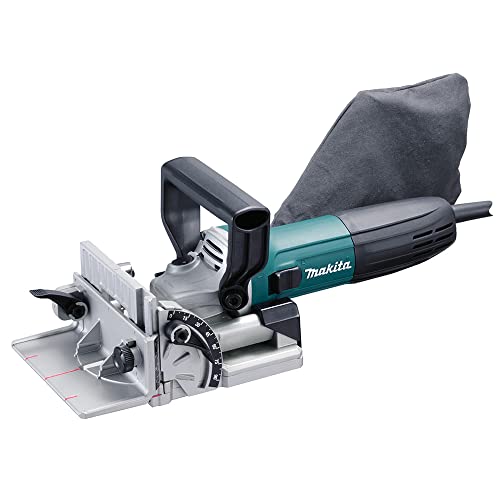
The PJ7000 takes a different fence approach: a cast aluminum pivot fence with positive stops at 0, 45 and 90 degrees. Pivot fences are quick to set for common frame and carcass angles, and the cast construction keeps the fence face flat and rigid. Six depth settings cover the #0, #10 and #20 sizes with finer steps between them, helping you center slots in thinner stock.
The 5.6 amp motor turns the 4-inch blade at 11,000 RPM, the fastest blade speed here, and maximum cutting depth is 3/4 inch. That suits shops cutting many slots in plywood and MDF carcasses, where clean, repeatable placement matters more than raw motor size. A 1-year warranty applies. Choose it if fence feel and depth-step control are your priorities.
| Brand | Product | ASIN | Key specs |
|---|---|---|---|
| Makita | PJ7000 Plate Joiner | B00608ZTD4 | 5.6 amp motor; 11,000 RPM; cast aluminum pivot fence with stops at 0, 45 and 90 degrees; six depth settings for #0, #10 and #20 biscuits; 4-inch blade; max cutting depth 3/4 inch; 1-year warranty |
PORTER-CABLE 557 Plate Joiner Kit
The 557 has the most versatile fence here. It tilts from 0 to 135 degrees with a positive stop at 90 degrees, so it can cut slots inside already-angled joints that a 90-degree fence cannot reach. A seven-position depth stop covers FF, #0, #10, #20, Simplex, Duplex and Max sizes, the widest range here.
What sets it apart is the second blade. Alongside the standard 4-inch blade, it accepts a 2-inch blade, making it the only pick here that cuts FF face-frame biscuits, the small biscuits sized for narrow rails. If your cabinet work includes face frames, that feature can decide the purchase by itself. The 7.0 amp, 120V motor runs at 10,000 RPM, and the kit includes a centering plate, dust bag, chip deflector and case.
| Brand | Product | ASIN | Key specs |
|---|---|---|---|
| PORTER-CABLE | Plate Joiner Kit, 7-Amp (557) | B00004YKUO | 7.0 amp motor; 120V; 10,000 RPM; fence tilts 0–135 degrees with positive stop at 90 degrees; accepts 4-inch and 2-inch blades; seven-position depth stop for FF, #0, #10, #20, Simplex, Duplex and Max biscuits; includes centering plate, dust bag, chip deflector and case |
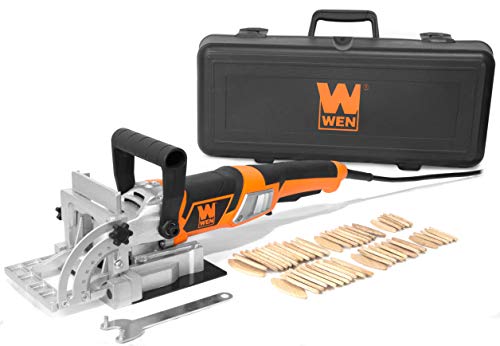
WEN JN8504 Biscuit Joiner
The JN8504 is the value route into biscuit joinery, and it arrives ready to work: the kit includes a case, a dust bag and 50 biscuits (24 #20, 16 #10, 10 #0), so a first project can start the day the tool lands. Pre-set stops cover the three standard sizes, and the fence and depth setup follow the same basic layout as the bigger brands.
Its 8.5 amp motor is the strongest on paper here and turns a 4-inch carbide-tipped blade at 10,000 RPM, so power is not the compromise. At 11.6 lb it is a heavier tool to guide along long edges. A 2-year warranty applies. For occasional furniture projects, shop cabinets and a first step into biscuit joinery, it covers the essentials in one box.
| Brand | Product | ASIN | Key specs |
|---|---|---|---|
| WEN | JN8504 8.5-Amp Plate and Biscuit Joiner with Case and Biscuits | B08BZX83N2 | 8.5 amp motor; 4-inch carbide-tipped blade; 10,000 RPM; pre-set stops for #0, #10 and #20 biscuits; includes case, dust bag and 50 biscuits (24 #20, 16 #10, 10 #0); 2-year warranty; item weight 11.6 lb |
DEWALT DCW682B 20V MAX XR Biscuit Joiner
The DCW682B is the cordless option, a brushless tool-only model on DEWALT’s 20V MAX XR platform. Battery, charger and biscuits are sold separately, so it makes most sense in a shop already running 20V MAX tools. At 5.5 lb tool only, per DEWALT’s own figures, it is easy to carry to the work, which suits site-built cabinets and assembly away from the main shop.
It keeps the dual rack-and-pinion fence of its corded sibling, with tool-free depth, height and bevel adjustments, an integral fence with 0 to 90 degree bevel capacity, and a depth knob for #0, #10 and #20 biscuits. The paddle switch works for left- or right-handed use. The 4-inch blade ships with an AirLock-compatible dust port, an angled dust port, a dust bag and wrenches. Coverage is a 3-year limited warranty with 1 year of free service and a 90-day money-back guarantee.
| Brand | Product | ASIN | Key specs |
|---|---|---|---|
| DEWALT | 20V MAX XR Biscuit Joiner, Brushless, Tool Only (DCW682B) | B0B39NZFRX | 20V MAX XR platform; tool only, battery and charger sold separately; tool weight 5.5 lb (tool only); dual rack-and-pinion fence; tool-free depth, height and bevel adjustments; fence bevel capacity 0–90 degrees; depth knob for #0, #10 and #20 biscuits; paddle switch; 4-inch blade; includes AirLock-compatible dust port, angled dust port, dust bag and wrenches; 3-year limited warranty |
How to Choose
Start with the fence, because it decides accuracy. Rack-and-pinion fences, like the two DEWALT models here, hold the fence parallel to the blade at any height, suiting edge joints in varied thicknesses. Pivot fences, like the Makita’s, snap quickly to common angles. If you cut face frames or angled joints, fence range matters more: the PORTER-CABLE tilts to 135 degrees and alone takes a 2-inch blade for FF biscuits.
Next, match depth stops to the biscuits you use. #20 biscuits handle most 3/4-inch stock, #10 suits thinner material, and #0 is for small frames and narrow rails. Extra depth positions, such as the Makita’s six settings or the PORTER-CABLE’s seven, give finer centering control. Then decide on power: corded models run all day at the bench, while the cordless DEWALT trades the cord for platform batteries bought separately.
Finally, plan for dust and safety. Use the dust bag or connect a vacuum, wear eye protection for every cut, and wear a dust mask or respirator rated for wood dust, especially with MDF and plywood. Unplug a corded joiner, or remove the battery pack, before changing blades or clearing a jam. Clamp the workpiece, keep hands clear of the plunge path, and test depth settings on scrap before cutting good stock.
Who should skip
Skip biscuit joinery if you only assemble an occasional flat-pack or repair, where dowels or screws will do with less setup. Skip it for heavy structural joints, too: biscuits excel at alignment, but a loaded joint in a chair or workbench calls for mortise-and-tenon or loose-tenon joinery. If you do not own DEWALT 20V MAX batteries, skip the DCW682B as a first joiner, because the bare tool still needs a battery and charger before it cuts anything. And if your projects never leave standard 3/4-inch casework, the PORTER-CABLE’s face-frame blade and wide fence range are capability you will rarely use.
FAQ
What biscuit size should I use for cabinet work?
Most 3/4-inch cabinet and furniture stock takes a #20 biscuit, the largest standard size. Step down to #10 for thinner panels and #0 for narrow rails and small frames. FF biscuits are smaller still and are made for face frames; in this group only the PORTER-CABLE 557 cuts them, with its 2-inch blade.
Can a biscuit joiner cut plywood and MDF as well as solid wood?
Yes. Biscuit joiners are designed for solid wood, plywood and MDF, and the alignment benefit is greatest in sheet goods, where wide panels are hard to keep flush during glue-up. Fine dust from MDF and plywood is a respiratory hazard, so use dust extraction and wear a suitable mask.
Is a cordless biscuit joiner as capable as a corded one?
For slot cutting, yes: the cordless DEWALT uses the same 4-inch blade class and rack-and-pinion fence design as its corded counterpart. The difference is workflow. Cordless suits assembly and site work, while corded models never pause for a battery swap during long glue-up sessions.
Do biscuits make a joint stronger?
Their main job is alignment: they keep faces flush and stop parts creeping while clamps are applied. A glued biscuit adds some shear resistance, but the long-grain glue surface does most of the holding. Treat biscuits as an alignment system first, not as structural joinery for high-load joints.
Final Verdict
As an all-round bench tool, the DEWALT DW682K remains the safe default, with the Makita PJ7000 close behind for anyone who prefers a pivot fence and finer depth steps. Cabinet builders who cut face frames should go straight to the PORTER-CABLE 557, the only pick that handles FF biscuits. The WEN JN8504 is the sensible entry point for occasional projects, and the cordless DEWALT DCW682B is the natural pick for shops already on the 20V MAX platform. Match the fence and the biscuit sizes to the work you actually build, and any of the five will keep your glue-ups flush.