Key takeaways
- Compare the best grout saws for removing old grout, from dual-blade hand saws and carbide tip tools to angled saws with spare blades for tile work.
- Top Pick: QEP 10057 Professional Grout Saw
- Runner-up: Coitak Tile Grout Saw with 3 Extra Blades
- Also consider: Blulu 11 Pieces Grout Tools Set
The best grout saw for most tile repair jobs is a hand saw with a carbide grit blade and a contoured handle, because it clears damaged grout from narrow joints without chipping the tile edges around it. If your joints are wide, a saw that stacks extra blades cuts faster. If the work is mostly corners and short runs, a carbide tip detail tool gives finer control than any full-size saw.
This guide compares five grout removal tools across the budget, mid-range, and premium tiers: a dual-blade professional hand saw, a carbide tip detail tool, an angled saw with spare blades, a full grout tool kit built around an angled saw, and a carbide oscillating blade for anyone who already owns a multi-tool. Each pick is judged on published specifications only: blade type, blade count, joint width range, and handle design.
As an Amazon Associate, we earn from qualifying purchases.
Table of Contents
- QEP 10057 Professional Grout Saw
- Goldblatt Grout Removal Tool with Replacement Carbide Tip
- Coitak Tile Grout Saw with 3 Extra Blades
- Blulu 11 Pieces Grout Tools Set
- Dremel MM500 Carbide Grout Removal Blade
- How to Choose a Grout Saw
- Frequently Asked Questions
- Conclusion
- Product and ASIN Reference
QEP 10057 Professional Grout Saw

The QEP 10057 is the most complete hand grout saw in this roundup, and it sits in the mid-range tier. It ships with two different blades in the handle package: one steel tooth blade for the first aggressive pass through a joint, and one carbide grit blade for finer removal and cleanup. That pairing matters because old cement grout dulls a plain toothed edge quickly, while the carbide grit edge keeps abrading the joint walls without needing much downward pressure.
The saw can hold up to three blades at once, which lets you widen the cut for broad floor joints, and a single blade is slim enough to work in joints around 1/16 inch wide. Blades swap with a Phillips head screwdriver, and QEP sells the 75011 carbide grit blades as replacements, so the tool stays useful across many regrouting jobs instead of becoming disposable once the first edge wears down.
Specs
- Blade types: steel tooth blade and carbide grit blade
- Blades included: 2
- Blade capacity: up to 3 blades for wide joints
- Minimum joint width: about 1/16 inch with a single blade
- Blade change: Phillips head screwdriver
- Handle: contoured plastic handle
- Replacement blades: QEP 75011, sold separately
Choose the QEP 10057 if you are clearing a whole shower or floor and want one hand tool that handles both the rough cut and the finishing pass. The contoured handle suits long push-and-pull sessions, and the stacked-blade option is the closest a hand saw gets to matching the pace of a powered tool on wide joints.
Goldblatt Grout Removal Tool with Replacement Carbide Tip
The Goldblatt grout removal tool takes a different approach from a bladed saw. Instead of a serrated edge, it pulls a triangular carbide tip through the joint, scraping grout out with a drawing motion. That design is slower across long straight runs, but it is far more precise in corners, around fixtures, and along the short joints where a full saw blade tends to skate onto the tile face. It sits in the premium tier of this group.
The tool measures 9.65 inches overall with a 4.92 inch handle, and the soft grip keeps the pulling motion controlled when you work at odd angles under a vanity or inside a shower niche. A spare carbide tip is included in the package, which extends the working life of the tool since the tip is the only part that wears. The rod between the tip and handle is carbon steel, giving the tool enough stiffness to bear down on hardened grout without flexing.
Specs
- Cutting element: triangular carbide tip
- Spare tip: 1 replacement carbide tip included
- Rod material: carbon steel
- Overall length: 9.65 inches
- Handle length: 4.92 inches
- Handle: soft grip
- Motion: pull scraping for detail work and corners
Pick the Goldblatt tool when the job is a repair rather than a full regrout: a cracked section of shower grout, a few stained joints near a tub, or detail cleanup after a bladed saw has done the heavy cutting. Many tilers keep both styles in the same bucket, using the saw for long runs and this tool for the ends of every line.
Coitak Tile Grout Saw with 3 Extra Blades
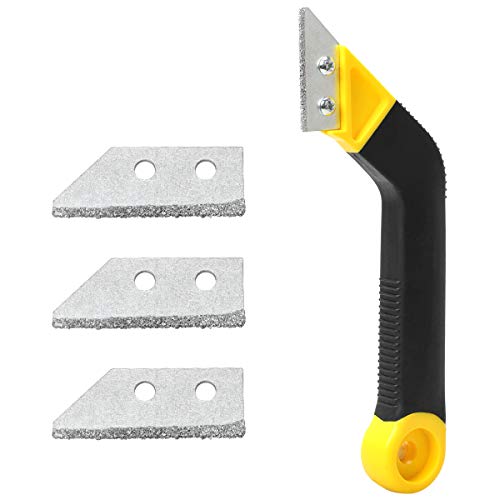
The Coitak grout saw is the budget tier pick, built around an angled blade that keeps your knuckles off the tile while the edge works down in the joint. The angled profile is the main reason to choose it: on floor work, a straight saw forces your hand low and close to the surface, while the offset shape here gives a more natural wrist angle over long sessions.
Three extra replacement blades come in the package, and the blade attaches to the handle with two screws, so a worn edge can be swapped with basic hand tools. The construction mixes iron and plastic, the tool weighs 4.2 ounces, and the handle runs about 8 inches long, which gives smaller hands a secure two-finger wrap behind the blade mount. The yellow finish is easy to spot in a crowded tool bucket or a dusty work area.
Specs
- Blade design: angled grout saw blade
- Extra blades: 3 replacement blades included
- Blade attachment: 2 screws
- Construction: iron and plastic
- Handle length: about 8 inches
- Item weight: 4.2 ounces
- Color: yellow
The Coitak suits single-room projects, rental turnovers, and anyone regrouting one bathroom who does not want to invest in a professional saw. The included spare blades cover the realistic lifespan of a one-bathroom job, and the angled shape reduces the hand fatigue that makes cheap straight saws unpleasant to use.
Blulu 11 Pieces Grout Tools Set

The Blulu set is the budget tier kit option, and it is the only pick here that covers the whole regrouting workflow in one package. Alongside the angled grout saw, the box includes a grout float, a grout bag, a grout remover scraper, six grout sponges, and a trowel, eleven pieces in total. For a first tile repair, that means the removal tool and the application tools arrive together instead of being gathered across several orders.
The saw itself is an angled design and ships with three blades, matching the pattern of the other angled saws in this guide. The scraper handles the residue and haze work after the saw opens the joint, and the float, bag, and sponges take over once new grout goes in. Nothing in the kit is built for daily professional use, but the breadth of the set is the point: it is a complete one-project solution.
Specs
- Total pieces: 11
- Grout saw: angled design with 3 blades
- Removal tools: grout saw and grout remover scraper
- Application tools: grout float, grout bag, and trowel
- Cleaning tools: 6 grout sponges
- Focus: removal plus regrouting in one kit
Choose the Blulu set if you own no tile tools at all and the project is a single bathroom or kitchen backsplash. If you already own floats and sponges, one of the dedicated saws above is the better buy, but as a first kit the coverage here is hard to match at the budget tier.
Dremel MM500 Carbide Grout Removal Blade
The Dremel MM500 is the premium tier powered option, and it is a blade rather than a complete tool. It mounts on an oscillating multi-tool and uses a carbide cutting edge to grind grout out of joints 1/8 inch wide and wider. For large floors or long shower walls, the oscillating action clears joints many times faster than hand sawing, and the narrow blade profile keeps the cut centered in the joint.
The blade uses a universal quick-fit interface and the listing names Bosch, Makita, Milwaukee, and Rockwell oscillating tools among the compatible brands, alongside Dremel Multi-Max tools. The blade is sold separately from the tool, so this pick only makes sense if a multi-tool is already in your kit. Dust control and a steady hand matter more with the powered route: the blade will wander if you rush, so slow passes along each joint give the cleanest result.
Specs
- Blade width: 1/8 inch
- Cutting edge: carbide
- Joint range: grout joints 1/8 inch and wider
- Interface: universal quick fit
- Named compatibility: Dremel Multi-Max, Bosch, Makita, Milwaukee, and Rockwell oscillating tools
- Tool included: no, blade only
Pick the MM500 when the area is large and a compatible multi-tool is already on hand. For a handful of joints, the hand saws above are simpler and quieter, but for a full floor the powered blade turns the slowest step of regrouting into the fastest one.
How to Choose a Grout Saw
Match the blade to the joint first. Narrow joints around 1/16 inch need a slim single blade like the QEP 10057 configuration, while joints at 1/8 inch and wider accept stacked blades or the Dremel MM500. Measure a few joints before ordering, because wall and floor joints in the same room often differ.
Decide between cutting and scraping. Bladed saws, whether toothed steel or carbide grit, cut on the push and pull and clear long runs quickly. Carbide tip tools like the Goldblatt scrape on the pull stroke and trade speed for control in corners and short sections. Many regrouting jobs go best with one of each.
Count the blades in the box. Grout is abrasive, and every blade in this guide dulls eventually. Picks that include spare blades or tips, like the Coitak and the Goldblatt, or that accept widely sold replacements, like the QEP, cost less over the life of the tool than a saw with a fixed edge.
Weigh the handle and the angle. An angled blade keeps knuckles clear of the tile and suits floor work, while a straight contoured handle gives more downward force on stubborn wall joints. If your project covers a whole room, handle comfort will matter more than any other single feature by the second hour.
Consider whether you need the rest of the workflow. A dedicated saw is the right buy for removal alone. If the same project includes floating new grout and washing it down, a kit like the Blulu set covers those steps without extra orders, and a powered blade like the Dremel MM500 is worth it only when a multi-tool is already in the garage.
Frequently Asked Questions
Can a grout saw damage the tile around the joint?
Yes, a grout saw can chip or scratch tile if the blade rides out of the joint, which is why controlled strokes and a blade narrower than the joint matter. Carbide grit edges are more forgiving than toothed steel because they abrade rather than bite, and angled saws help by keeping the blade aligned with the joint instead of your hand.
How long does a grout saw blade last?
Blade life depends on grout hardness and joint length, but a single carbide grit blade typically handles one bathroom regrout before it slows noticeably. Sanded and epoxy grouts wear edges faster than unsanded grout. Picks with spare blades in the box, or with replacements sold separately, avoid a mid-project pause.
Is a hand grout saw enough, or do I need a powered tool?
A hand grout saw is enough for repairs, single walls, and most single-bathroom regrouts, and it gives the most control near delicate tile. A powered oscillating blade earns its place on large floors and long runs, where hand sawing the same area would take several times longer and tire your arm well before the last joint.
Should I remove all of the old grout before regrouting?
Remove the grout down to a depth that gives the new grout a solid base, commonly at least half the thickness of the tile, and clear out any loose or crumbling material the saw exposes. Sound grout buried deep in the joint can stay, but every cracked or powdery section should come out so the new grout bonds evenly along the whole line.
Conclusion
For most regrouting work, the QEP 10057 is the best grout saw here: two blade types in the box, room for stacked blades on wide joints, and replacements that are easy to find. The Goldblatt carbide tip tool is the better choice for corners and small repairs, the Coitak covers budget single-room jobs with spare blades included, the Blulu kit equips a first-time tiler for the whole workflow, and the Dremel MM500 is the fast lane for anyone who already owns an oscillating multi-tool. Match the blade width to your joints, keep a spare edge on hand, and any of these five will clear old grout cleanly.