Key takeaways
- Compare the best marking gauges for woodworking, from micro-adjust brass wheel gauges to budget scriber kits, with specs on beams and cutters.
- Top Pick: Taytools 464763 Solid Brass Wheel Marking Gauge — Premium
- Runner-up: Clarke Brothers Wheel Marking Gauge — Mid-range
- Also consider: Taytools 465494 Wheel Marking Gauge — Mid-range
The short answer: a wheel marking gauge with a solid brass fence and a hardened steel cutting wheel gives you the cleanest, most repeatable layout lines for joinery, because the round cutter severs wood fibers instead of tearing them the way a pin does. The five gauges below cover the main buying angles, from a micro-adjust premium model for fine dovetail and mortise work, through mid-range brass gauges with engraved scales, to a budget kit that bundles two cutter styles for learning the tool.
A marking gauge does one job: it scribes a line at a fixed distance from a reference edge. That single line sets the shoulder of a tenon, the baseline of a dovetail, the cheek of a rabbet, and the wall of a mortise. Because the fence rides the edge of the board and the cutter sits at a set distance along the beam, every pass repeats the same dimension without measuring again, and a saw or chisel can follow the scribed groove directly.
As an Amazon Associate, we earn from qualifying purchases.
Table of Contents
- What a marking gauge does in the shop
- The 5 best marking gauges
- Taytools 464763 Solid Brass Wheel Marking Gauge
- Clarke Brothers Wheel Marking Gauge
- Taytools 465494 Wheel Marking Gauge
- iGaging Wheel Marking Gauge
- YOSELIN Dovetail Jig Wheel Marking Gauge Tool Set
- How to choose a marking gauge
- Frequently asked questions
- Conclusion
- Product and ASIN Reference
What a marking gauge does in the shop
Three cutter styles dominate this category. A pin gauge drags a pointed steel pin along the wood; it is simple and traditional, but the pin can follow the grain and wander on figured stock. A cutting gauge uses a small knife blade, which slices across the grain well but needs more care to keep registered. A wheel gauge carries a small round cutter at the end of the beam. The wheel rolls as it cuts, so it tracks straight with and across the grain, and its beveled edge pulls the fence tight against the reference face as you draw the tool along. That self-registering action is why wheel gauges have become the default choice for furniture joinery.
Two other design points decide how a gauge feels in daily use. The first is the fence, also called the head: a wide, heavy fence in brass stays flat against the edge and resists tipping, while a small or light fence can rock and change the line. The second is the lock and adjustment. A simple thumbscrew lock is fast and adequate for most work. A micro-adjust head adds threaded fine adjustment, so you can creep up on an exact setting in small steps while the fence stays put, which pays off when a joint has to match a mating piece rather than a number on a rule.
The 5 best marking gauges
1. Taytools 464763 Solid Brass Wheel Marking Gauge — Premium
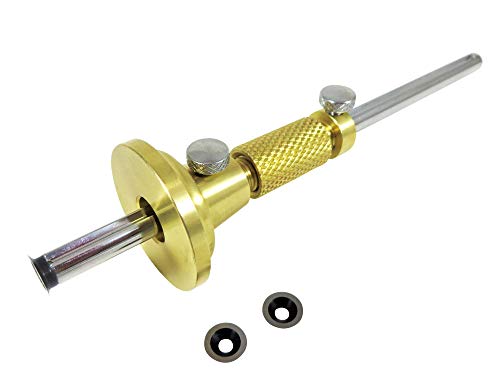
The Taytools 464763 is built around fine adjustment. Its head is machined from solid brass at 1.625 inches in diameter, and it carries a lockable micro-adjust mechanism with a knurled adjustment knob and tail. Instead of loosening the fence, nudging the beam by eye, and locking again, you dial the cutter position in small increments and then lock it down. For layout that must match an existing part, such as fitting a tenon to a mortise that is already cut, that control is the reason to choose this tier.
The beam is hardened steel, 7 inches long and 5/16 inch in diameter, grooved along its length so the head cannot rotate while you adjust it. The cutter is a hardened round wheel of 3/8 inch diameter, and the head has a countersink that the cutter retracts into when the gauge is put away, protecting the edge. Two extra cutters come in the box, so a nicked wheel does not stop a project. At 8.8 ounces the tool has the heft to register firmly against an edge. One trade-off to note: the beam carries no graduated scale, so settings are taken from a separate rule or from the workpiece itself.
Specs
– Tier: premium
– Head: solid brass, 1.625 in diameter, micro-adjust lockable design with knurled knob and tail
– Beam: hardened steel, 7 in long, 5/16 in diameter, grooved to prevent head rotation
– Cutter: hardened round wheel, 3/8 in diameter; retracts into a countersink in the head
– Included cutters: 3 total, 1 fitted and 2 spare
– Weight: 8.8 oz
– Beam graduations: none; set against a separate rule or the workpiece
2. Clarke Brothers Wheel Marking Gauge — Mid-range

The Clarke Brothers gauge pairs a solid brass fence with a hardened steel rod and cutter, in an all-metal build with no wooden insert. The fence head has two flat spots machined into it, a small detail that solves an everyday annoyance: a round-headed gauge rolls on the bench, while this one sits still where you set it down. The fence adjusts with dual thumbscrews and includes a micro-adjuster, so fine settings are possible without moving up to the premium tier.
The rod carries a graduated scale in both inch and millimeter units reading to 6 inches and 150 mm, which makes it easy to set the gauge straight from a drawing dimension. Overall length is 7 inches and 180 mm. Two replacement cutters are included in the kit, extending the working life of the tool before any spare parts order is needed. This is the balanced choice for a woodworker who wants a readable scale, a roll-stop head, and fine adjustment in one mid-range package.
Specs
– Tier: mid-range
– Fence: solid brass head with two flat roll-stop spots
– Rod: hardened steel with graduated inch and millimeter scale to 6 in and 150 mm
– Adjustment: micro-adjust fence with dual thumbscrews
– Cutter: hardened steel round cutting wheel
– Included cutters: 2 replacement cutters in the kit
– Overall length: 7 in (180 mm)
3. Taytools 465494 Wheel Marking Gauge — Mid-range

The 465494 is the Taytools option for buyers who want a fully featured gauge without a micro-adjust mechanism. The head is precision machined from solid brass, not plated, and measures 1-9/16 inches in diameter by 1-3/16 inches tall. That mass rides on a hardened steel beam of .310 inch diameter, a rigid combination that supports repeatable scribes up to seven inches deep from an edge without noticeable beam flex.
The cutting wheel is hardened high-speed steel at 7/16 inch in diameter, a step larger than the wheel on many gauges, and the beam is black-chrome plated. The dark plating resists corrosion and gives the engraved SAE and metric graduations a high-contrast background, so the scale stays readable in ordinary shop light. A knurled thumb screw locks the head to the beam, and replacement cutters are available from the maker. Choose this model when a graduated beam and a larger cutter matter more than dial-in fine adjustment.
Specs
– Tier: mid-range
– Head: solid brass, 1-9/16 in diameter by 1-3/16 in tall, knurled thumb screw lock
– Beam: hardened steel, .310 in diameter, black-chrome plated
– Marking depth: up to 7 in from an edge
– Cutter: hardened high-speed steel wheel, 7/16 in diameter
– Scale: engraved SAE and metric graduations on the beam
– Replacement cutters: available from the maker
4. iGaging Wheel Marking Gauge — Budget
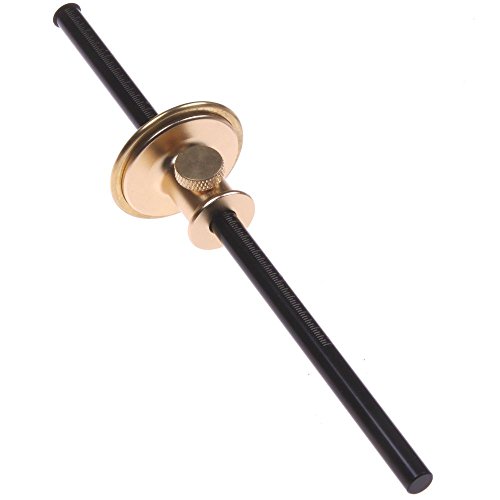
The iGaging gauge is the straightforward pick for a first wheel gauge or a second gauge that stays set to one dimension. It has a solid brass head with a knurled lock nut that tightens by hand, and an 8 inch steel shaft graduated in 1 mm and 1/32 inch increments, so a setting can be read directly off the shaft instead of against a separate rule. The reach of the longer shaft suits wider boards and deeper casework layout.
The cutting wheel on this model is a non-rotating, locked design, well suited to dense hardwoods, where it cuts a firm line. The tool also doubles as a depth gauge: set the shaft against a reference and use it to transfer or check the depth of a mortise, groove, or dado. At 4.96 ounces it is light enough for comfortable one-hand use. This tier keeps the essential brass-and-steel construction and the dual-unit scale, and leaves out micro-adjustment, which is the honest trade at this level.
Specs
– Tier: budget
– Head: solid brass with knurled lock nut
– Shaft: steel, 8 in, graduated in 1 mm and 1/32 in increments
– Cutter: non-rotating locked cutting wheel
– Added role: doubles as a depth gauge for measurement transfer
– Weight: 4.96 oz
5. YOSELIN Dovetail Jig Wheel Marking Gauge Tool Set — Budget
The YOSELIN set takes a different approach: instead of one cutter, it includes two. A rotating bearing cutter handles softwood, where a free-spinning wheel glides through earlywood with less tearing, and a locked cutter swaps in for hardwood. The body is CNC-machined aluminum with an anodized finish, lighter than the brass gauges above, and the 8 inch precision steel rod is graduated in millimeter and 1/64 inch marks for fine reading.
The kit rounds itself out with layout accessories: a pencil holder attachment, a mini screwdriver for cutter changes, a woodworking pencil, and a bow-tie dovetail guide that helps set out dovetail angles without a separate template. For a beginner building a first layout kit, the two-cutter system teaches the difference between cutter styles in a way a single-cutter gauge cannot. The aluminum body gives up some of the registering heft of brass, which is the compromise that comes with this tier.
Specs
– Tier: budget
– Body: CNC-machined aluminum, anodized finish
– Rod: precision steel, 8 in, graduated in millimeter and 1/64 in marks
– Cutters: rotating bearing cutter for softwood and locked cutter for hardwood
– Kit contents: pencil holder, mini screwdriver, woodworking pencil, bow-tie dovetail guide
– Adjustment: knurled locking knob
How to choose a marking gauge
Cutter style comes first. For general furniture work in both softwood and hardwood, a wheel cutter is the most forgiving choice: it severs fibers with and across the grain and resists wandering. A locked wheel favors hard, dense species. A rotating bearing wheel favors softwood. Pin gauges remain serviceable for rough work, but they tear fibers across the grain and can follow grain lines on figured stock.
Fence size and material set the feel. A fence around 1-1/2 inches in diameter or larger, in solid brass, registers flat and stays put. Smaller fences and light aluminum bodies carry easily in an apron pocket but demand a steadier hand to keep the line true.
Beam length and rigidity set the reach. Most joinery layout happens within 6 inches of an edge, and a 7 or 8 inch beam covers that range with room to spare. Beam diameter matters as much as length: a beam near 5/16 inch in hardened steel flexes far less at full extension than a thin rod.
Scales and adjustment are about workflow. If you set the gauge from drawings, an engraved dual-unit scale on the beam saves a step. If you set it from the workpiece itself, the more accurate habit for fitted joints, a plain beam is no drawback, and a micro-adjust head becomes the feature worth paying for, since it lets you sneak up on a fit in fine increments.
Spares extend the tool’s life. A cutting wheel is a wear part. Kits that include one or two extra cutters keep the tool in service for years without a separate parts purchase.
Frequently asked questions
What is the difference between a wheel marking gauge and a pin marking gauge?
A pin gauge marks with a pointed steel pin that drags through the fibers, while a wheel gauge cuts with a small round wheel that rolls as it severs them. The pin can tear fibers across the grain and drift with the grain on figured wood. The wheel leaves a cleaner, finer line in both directions, and its bevel helps hold the fence against the edge, which is why wheel gauges are the common choice for visible joinery.
How deep can a marking gauge reach from an edge?
Reach is set by beam length minus the width of the fence. The gauges in this guide mark up to about 7 inches from an edge, which covers the shoulder lines, baselines, and casework layout of most furniture projects. Wider panels are usually marked from both edges, so reach beyond 7 inches is rarely the limiting factor in bench work.
Can a wheel marking gauge mark across the grain?
Yes. Cross-grain marking is where a wheel gauge earns its place, because the rolling cutter slices the fibers cleanly instead of tearing them the way a dragging pin does. The resulting groove also gives a chisel or saw a physical track to register in, which keeps a shoulder line crisp when the joint is cut. Light pressure and two passes, a faint line first and a firmer line second, give the cleanest result.
How do you sharpen a marking gauge cutter wheel?
The flat face of the wheel is the surface to maintain. Lay that face on a fine diamond stone and rub it in small circles or a figure-eight motion until a slight burr forms on the bevel side, then touch the bevel lightly to remove the burr. Avoid regrinding the bevel angle, which is easy to spoil freehand. Gauges that ship with spare cutters let you swap in a fresh wheel and sharpen the dull one later, at a convenient moment.
Conclusion
For most woodworkers, the Clarke Brothers gauge is the balanced buy: a brass roll-stop fence, a dual-unit scale, micro-adjustment, and spare cutters in a mid-range package. If your work is fine fitted joinery and you set the gauge from the workpiece rather than a rule, the Taytools 464763 and its lockable micro-adjust head are worth the premium tier. The Taytools 465494 suits anyone who prefers a graduated black-chrome beam and a larger cutter. On a budget, the iGaging covers the essentials in brass and steel and doubles as a depth gauge, while the YOSELIN kit adds a second cutter style and dovetail accessories for learning the craft.