Key takeaways
- Compare the best push sticks and push blocks for table saws, router tables, and jointers by grip design, leg width, handle shape, and set contents.
- Top Pick: MICROJIG GRR-RIPPER GR-100 3D Pushblock
- Runner-up: Milescraft 3406 GrabberPRO Push Block
- Also consider: POWERTEC Deluxe Push Stick 2PK (71511)
The best push stick for most table saw work is a long notched stick that keeps your hand well behind the blade, while the best push block is a handled pad that adds downward pressure on a jointer or router table. The MICROJIG GRR-RIPPER GR-100 leads this roundup as the premium pick because its adjustable legs ride on both sides of the blade and feed narrow stock with three-directional control. The Milescraft GrabberPRO follows with four swappable legs for thin rips, the POWERTEC Deluxe Push Stick 2PK covers classic stick work, and two multi-piece sets round out the budget tier for shops that want sticks and blocks in one box.
As an Amazon Associate, we earn from qualifying purchases.
Table of Contents
- Quick Answer
- How These Push Tools Compare
- 1. MICROJIG GRR-RIPPER GR-100 3D Pushblock
- 2. Milescraft 3406 GrabberPRO Push Block
- 3. POWERTEC Deluxe Push Stick 2PK (71511)
- 4. POWERTEC Push Block and Push Stick Set 5PK (71009V)
- 5. Fulton 4 Piece Woodworking Safety Kit (11553)
- Push Stick or Push Block: Which Shape Suits the Cut
- How to Choose a Push Stick or Push Block
- Care and Storage
- FAQ
- Conclusion
- Product and ASIN Reference
Quick Answer
Short on time, here is the shortlist. The MICROJIG GRR-RIPPER GR-100 is the premium system for narrow rips and full control at the table saw. The Milescraft GrabberPRO is the adjustable push block for thin strips, with legs down to one eighth of an inch. The POWERTEC Deluxe Push Stick 2PK pairs a magnetic stick with an L-shaped stick for everyday feeding. The POWERTEC 5PK set adds hold-down blocks for jointer and router table work, and the Fulton 4 Piece Kit is the budget bundle that adds a featherboard to the mix.
| Product | Type | Key Feature | Tier |
|---|---|---|---|
| MICROJIG GRR-RIPPER GR-100 | Push block system | Adjustable legs straddle the blade | Premium |
| Milescraft 3406 GrabberPRO | Push block | Four interchangeable legs to 1/8 inch | Premium |
| POWERTEC Deluxe Push Stick 2PK (71511) | Push stick pair | Magnetic stick plus L-shaped stick | Mid-range |
| POWERTEC Push Block and Push Stick Set 5PK (71009V) | Mixed set | Three blocks and two sticks | Budget |
| Fulton 4 Piece Woodworking Safety Kit (11553) | Mixed set | Featherboard and magnetic stick | Budget |
How These Push Tools Compare
Every tool below was compared on the details makers publish in their listings and manuals. Form comes first, because a stick and a block do different jobs: a stick hooks the back edge of the stock and pushes from behind, while a block sits on top of the stock and adds downward pressure along with the forward push. Grip design comes next, covering notched heels, rubber pads, and contoured handles, since a tool that slips mid-cut fails at its one job. Published dimensions matter too, because leg width decides how narrow a strip a block can feed, and stick length decides how far your hand stays from the blade. Set contents round out the comparison, since several picks bundle blocks, sticks, and featherboards a shop would otherwise buy one piece at a time.
1. MICROJIG GRR-RIPPER GR-100 3D Pushblock
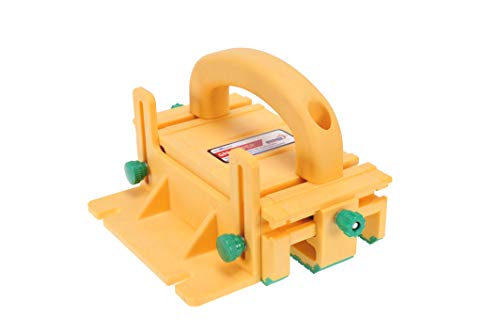
The GRR-RIPPER GR-100 is the most engineered tool in this roundup, a push block system built around two adjustable legs that ride on either side of the blade. The legs move to match the width of the cut, so the block keeps downward, forward, and inward pressure on the stock through the whole pass. That three-direction control is the point of the design: the workpiece stays flat on the table and tight against the fence instead of drifting or lifting at the back of the blade. A moving blade guard shield and the maker grip material on the leg bottoms add to the hold. The system works on table saws, router tables, band saws, and jointers, and the maker rates it for ripping stock down to a quarter inch wide. It is the pick for a shop that rips narrow strips often and wants one tool configured to the cut.
Specs
- Model: GR-100
- Type: Adjustable 3D push block system
- Legs: Adjustable main body with 1/4 inch and 1/2 inch leg setup
- Grip surface: Maker non-slip grip material on the leg bottoms
- Machines: Table saws, router tables, band saws, jointers
- Minimum rip width: 1/4 inch per the maker
- Color: Yellow
2. Milescraft 3406 GrabberPRO Push Block
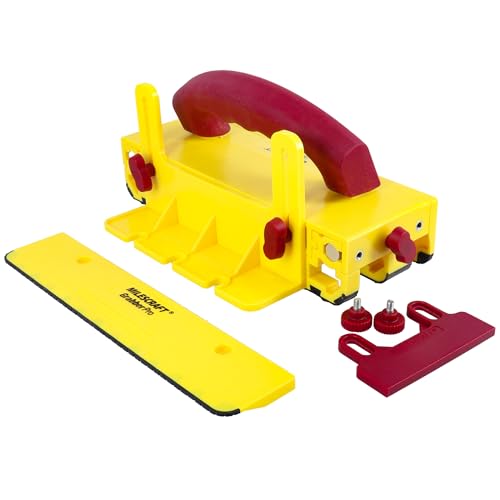
The GrabberPRO takes a different route to the same problem. Instead of legs that slide, it ships with four interchangeable push block legs in 1 inch, 1/2 inch, 1/4 inch, and 1/8 inch widths, and you fit the leg that matches the strip you are cutting. The narrowest leg makes the GrabberPRO the thin-rip specialist in this group, suited to feeding slim strips that a fixed-width block would crowd against the fence. An angled support foot at the back hooks the end of the stock for forward drive, and the underside carries a raised grip pattern of non-marring pads. The body is molded ABS with a tall handle that keeps fingers up and away from the cutter, and the bright yellow finish is easy to spot on a crowded bench. Choose it when your work runs to thin strips and you want the tool footprint to shrink with the stock.
Specs
- Model: 3406 GrabberPRO
- Type: Push block with interchangeable legs
- Legs included: 1 inch, 1/2 inch, 1/4 inch, and 1/8 inch push block legs
- Grip surface: Non-marring diamond grip pattern pads
- Body material: ABS plastic
- Support: Angled support foot for end-of-stock drive
- Machines: Table saws, router tables, band saws
- Weight: About 1 pound
3. POWERTEC Deluxe Push Stick 2PK (71511)

The POWERTEC Deluxe set is the classic stick option, a two-piece pair covering the two stick shapes most shops reach for. One stick is a straight magnetic push stick, 11-21/32 inches long with a 9/16 inch notch, and magnets in the handle let it park on the saw cabinet or fence rail between cuts. The second is an L-shaped stick, 8-21/32 inches by 5-15/16 inches with a 35/64 inch pad, which puts a wider foot on the stock for shorter pieces. Both handles are contoured for a firm grip, and the maker lists the pair for table saws, router tables, band saws, and jointers. There are no pads or legs to adjust here, and that simplicity is the appeal: the stick hangs by the saw, hooks the back edge of the board, and feeds it through. For general ripping in a home shop, this pair covers the daily work at a mid-range tier.
Specs
- Model: 71511
- Type: Two-piece push stick set
- Stick 1: Magnetic push stick, 11-21/32 inches long, 9/16 inch notch width
- Stick 2: L-shaped push stick, 8-21/32 x 5-15/16 inches, 35/64 inch pad width
- Handles: Contoured ergonomic handles, magnetic storage on one stick
- Machines: Table saws, router tables, band saws, jointers
- Pack count: 2 sticks
4. POWERTEC Push Block and Push Stick Set 5PK (71009V)
The POWERTEC 5PK is the mixed set for a shop that wants blocks and sticks in one purchase. The box holds one long hold-down push block, two short hold-down push blocks, one V stick, and one straight push stick. The blocks carry the downward-pressure work on a jointer or router table, with wide handles that keep hands above the stock, while the two sticks handle table saw feeding: the V stick centers on the edge of narrow stock and the straight stick covers general rips. Handles across the set use the maker Max Grip shaping, and everything is molded in safety orange. As a single box that outfits a table saw, a jointer, and a router table, the 5PK is the value pick here, suited to a new shop building its safety kit from zero.
Specs
- Model: 71009V
- Type: Five-piece push block and push stick set
- Contents: 1 long hold-down push block, 2 short hold-down push blocks, 1 V stick, 1 straight push stick
- Handles: Dual ergonomic handles with maker Max Grip shaping
- Color: Safety orange
- Machines: Table saws, router tables, band saws, jointers
- Pack count: 5 pieces
5. Fulton 4 Piece Woodworking Safety Kit (11553)

The Fulton kit, sold by Peachtree Woodworking Supply, bundles four feeding and holding tools in safety orange: a multi-mount featherboard, a magnetic handle push stick, a straight handle push block, and an angled handle push block. The featherboard is the piece the other sets lack: it mounts in a miter slot or T-track and presses stock against the fence with flexible fingers, which pairs with the push stick for long rips. The magnetic handle stick measures about 12 inches long and carries a 90-degree notch with a relief circle at the end, cut to accept the corner of the stock. The two blocks cover jointer and router table feeding, one with a straight handle and one angled for a more natural wrist position. For a budget tier kit that covers holding, guiding, and feeding in one box, the Fulton set is hard to match.
Specs
- Model: 11553
- Type: Four-piece woodworking safety kit
- Contents: Multi-mount featherboard, magnetic handle push stick, straight handle push block, angled handle push block
- Push stick: About 12 inches long, 90-degree notch with relief circle, magnetic handle
- Color: Safety orange
- Machines: Table saws, router tables, band saws, jointers
- Pack count: 4 pieces
Push Stick or Push Block: Which Shape Suits the Cut
The two tool shapes divide the work cleanly. A push stick works from behind the stock: its notched heel hooks the back edge, and the length of the stick keeps your hand a foot or more behind the blade. Sticks are the right shape for ripping on the table saw, especially as the piece gets narrow. A push block works from above the stock. Its pad presses down while the handle drives forward, which is what a jointer needs over the cutterhead and what a router table needs along an edge. The adjustable systems, the GRR-RIPPER and the GrabberPRO, blur the line by straddling the blade with legs, giving block-style downward pressure in the middle of a table saw rip. Most shops end up with both shapes, and the mixed sets in this roundup exist for exactly that reason.
How to Choose a Push Stick or Push Block
Begin with the machines you own. A table saw alone calls for sticks and a blade-straddling block, while a jointer makes hold-down blocks a necessity, since feeding a board over a cutterhead with bare hands is never the right plan. Next, look at the narrowest stock you cut. Fixed pads and legs suit general work, but strips under a half inch call for an adjustable system or a thin leg, which is where the GRR-RIPPER and the GrabberPRO earn their tier. Then weigh grip: rubber and patterned pads hold smooth stock without slipping, while a notched heel gives a positive hook on rough lumber. Handle shape matters over a long session too: tall handles keep knuckles clear, and angled handles suit jointer work. Finish with storage and visibility. Magnetic handles park on the machine itself, and bright colors keep the tool visible in shavings and offcuts.
Care and Storage
Push tools are sacrificial by design. A stick or block that catches a blade has done its job, so inspect heels, legs, and pads after any contact and retire a piece that has lost its notch or had a leg cut away. Keep grip pads clean, because a pad loaded with dust and pitch slips on the next board; a wipe with a damp cloth and mild soap restores most rubber surfaces. Check handles and knobs for cracks, and snug any leg hardware on adjustable blocks so the setup holds its setting through a cut. Store sticks where they belong: magnetic models on the saw cabinet, others on a hook beside the machine, within reach of the feeding position. A push tool stored out of reach is a push tool that gets skipped.
FAQ
When should a push stick replace your hand at the table saw?
Use a push stick whenever the cut puts your hand close to the blade, which in practice means narrow rips, short stock, and the final section of any long rip. A common shop rule is to switch to a stick when the space between the blade and the fence is narrower than the width of your hand.
Can one push block serve a table saw, a jointer, and a router table?
Yes, within limits. Wide hold-down blocks with pads move between a jointer and a router table well, and adjustable systems like the GRR-RIPPER are listed for all three machines. A plain notched stick, though, belongs at the table saw, since it gives no downward pressure over a jointer cutterhead.
How narrow a strip can an adjustable push block feed?
The GRR-RIPPER is rated by its maker for rips down to a quarter inch wide, and the Milescraft GrabberPRO includes a leg one eighth of an inch wide for thin strips. For stock narrower than the thinnest leg, a dedicated thin-strip jig is the safer tool for the job.
Do featherboards replace push sticks?
No. A featherboard holds stock against the fence or table with spring pressure, but it does not feed the piece forward. The Fulton kit pairs the two for that reason: the featherboard keeps the board registered while the stick drives it through the cut.
Conclusion
A push stick or push block is the cheapest safety upgrade in the shop, and the right shape depends on the machine and the cut. The MICROJIG GRR-RIPPER GR-100 is the premium system for narrow rips with full control, and the Milescraft GrabberPRO matches it for thin-strip work with swappable legs. The POWERTEC Deluxe 2PK covers classic stick feeding, while the POWERTEC 5PK and the Fulton 4 Piece Kit outfit a whole shop at a budget tier, the Fulton adding a featherboard. Pick the tool that fits your narrowest cut and most-used machine, keep it stored at that machine, and every rip gains distance between your hand and the blade.