Key takeaways
- Compare the best welding helmets for MIG, TIG and stick welding, covering viewing area, optical clarity, shade range, sensors and published specs.
- Top Pick: Quick Comparison
- Runner-up: Quick Comparison
- Also consider: Quick Comparison
If you weld with MIG, TIG or stick equipment, the best welding helmet for most people is the Lincoln Electric VIKING 3350. It pairs a perfect 1/1/1/1 optical clarity rating with a 12.5 square inch viewing area and arc sensors rated down to 2 amps, so it handles delicate TIG work and heavy fabrication alike. Welders who prefer digital controls should look at the ESAB Sentinel A50, with its color touch screen and eight memory settings. The Hobart Inventor 770890 anchors the mid-range with a PureColor lens and simple analog knobs, while the YESWELDER LYG-M800H offers a wide true color window and solar assisted power at a mid-range tier. The Antra AH7-220-0000 is the budget pick for occasional garage and farm work. Every helmet in this guide is an auto-darkening model, and every figure quoted comes from specifications the makers publish themselves: viewing area, shade range, switching speed, sensor count, TIG rating and weight. Match those numbers to the way you weld and the right choice becomes clear.
As an Amazon Associate, we earn from qualifying purchases.
Table of Contents
- What to Look for in a Welding Helmet
- Quick Comparison
- 1. Lincoln Electric VIKING 3350 (K3034-4)
- 2. ESAB Sentinel A50 (0700000800)
- 3. Hobart Inventor 770890
- 4. YESWELDER LYG-M800H
- 5. Antra AH7-220-0000
- Frequently Asked Questions
- Conclusion
- Product and ASIN Reference
What to Look for in a Welding Helmet
Optical clarity. Auto-darkening lenses carry an EN 379 rating made of four numbers, covering optical clarity, light diffusion, shade consistency and angular dependence. A 1/1/1/1 score is the highest grade in all four categories and gives the most natural view of the puddle. A 1/1/1/2 lens gives up a little angular consistency and usually sits in a lower price tier.
Viewing area. A larger window helps you track the joint, read the puddle and keep your bearings when welding out of position. Compact helmets offer roughly 6 to 7 square inches, mid-range models reach about 9 square inches, and the largest windows exceed 12 square inches.
Shade range. Most MIG and stick work falls between shades 10 and 13. A variable 9-13 range covers the majority of home and shop welding. A wider 5-13 range adds lighter shades for plasma cutting, grinding prep and low amperage TIG work, which makes one helmet cover more jobs.
Arc sensors. Sensors trigger the darkening. Two sensors are adequate for flat bench work with a clear line of sight. Four sensors keep the lens dark when a workpiece, a fixture or your own arm blocks one sensor, which matters for out-of-position and pipe work.
Switching speed. This is how fast the lens darkens when the arc fires. Figures of 1/25,000 of a second are typical of quality helmets, and faster speeds reduce the flash your eyes register at the moment of the strike.
TIG rating. Low amperage TIG arcs are faint, and a helmet whose sensors only wake up at higher currents can flicker. A rating of 2 amps or lower suits TIG work; a floor above 5 amps limits a helmet to MIG and stick duty.
Power and weight. Solar assisted lenses stretch battery life, while plain battery models depend on a replaceable cell. Weight matters over a long day: helmets in this guide run from about 20 ounces to a little over 2 pounds, and multi-point headgear spreads that load across the head instead of the neck.
Quick Comparison
| Helmet | Tier | Viewing Area | Shade Range | Arc Sensors |
|---|---|---|---|---|
| Lincoln Electric VIKING 3350 (K3034-4) | Premium | 12.5 sq in | 5-13 | 4 |
| ESAB Sentinel A50 (0700000800) | Premium | 3.93 x 2.36 in | 5-13 | 4 |
| Hobart Inventor 770890 | Mid-range | 9.3 sq in | 9-13 | 4 |
| YESWELDER LYG-M800H | Mid-range | 3.93 x 3.66 in | 3/5-9/9-13 | 4 |
| Antra AH7-220-0000 | Budget | Not published | 9-13 | 2 |



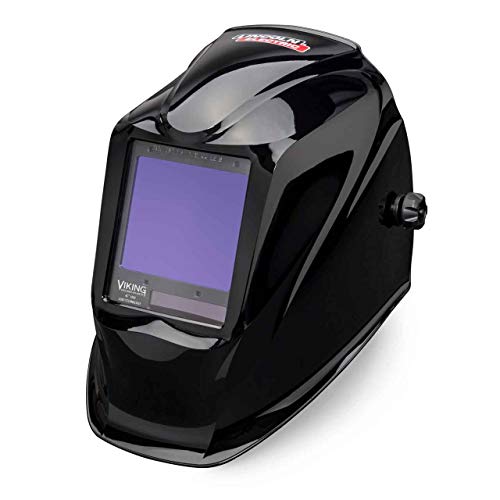
1. Lincoln Electric VIKING 3350 (K3034-4)
The VIKING 3350 is Lincoln Electric’s flagship auto-darkening line, and the matte black K3034-4 is the version most fabricators choose. Its 4C lens technology targets the four qualities welders judge a lens by: clarity, color, light weight and a consistent shade from any viewing angle. The result is a 1/1/1/1 optical rating and a real color view that makes it easier to read puddle edges and tell heated metal apart from slag.
The window is the largest in this guide at 3.74 by 3.34 inches, or 12.5 square inches, which helps when you need to see the joint ahead of the arc. Four arc sensors and a TIG rating of 2 amps on both AC and DC keep the lens reliable on faint TIG arcs. The variable shade runs from 5 to 13 with internal controls, and an external button switches to grind mode at shade 3.5. The X6 headgear distributes the 21 ounce weight across six contact points, and the cartridge accepts magnifying cheater lenses. Power comes from a replaceable CR2450 battery, so a spare cell in the toolbox keeps the helmet working. For welders who spend full days under the hood, this is the most complete specification sheet here.
Specs
- Viewing area: 3.74 x 3.34 in (95 x 85 mm), 12.5 sq in
- Optical clarity: 1/1/1/1
- Lens technology: 4C Lens Technology
- Shade range: variable 5-13, internal controls
- Grind mode: shade 3.5, external grind button
- Switching speed: 1/25,000 of a second
- Arc sensors: 4
- TIG rating: 2 amps and above, AC and DC
- Weight: 21 oz (595 g)
- Headgear: X6 Headgear
- Power source: replaceable CR2450 battery
- Magnifying lens capable: yes
2. ESAB Sentinel A50 (0700000800)
The Sentinel A50 takes a different route to premium performance, with a low profile nylon shell and a fully digital cartridge. Its color touch screen sits inside the helmet and stores eight memory settings, so a welder who rotates between MIG, TIG and stick jobs can recall a saved shade, sensitivity and delay combination instead of dialing it in each time. An external grind button on the shell switches modes without lifting the hood.
The viewing area measures 3.93 by 2.36 inches (100 x 60 mm), and the optical class is 1/1/1/2, one step below the Lincoln on angular consistency. The variable shade spans 5 to 13, the low amperage TIG range reaches down to 2 amps, and four arc sensors watch for the strike. The cartridge itself measures 5.2 by 4.5 by 0.35 inches. ESAB rates the helmet to ANSI Z87.1 and CSA Z94.3, and backs it with a three year warranty. Welders who like digital readouts and saved presets will find the A50 the most modern control layout in this guide.
Specs
- Viewing area: 3.93 x 2.36 in (100 x 60 mm)
- Optical class: 1/1/1/2
- Shade range: variable 5-13
- Cartridge dimensions: 5.2 x 4.5 x 0.35 in (133 x 114 x 9 mm)
- Arc sensors: 4
- Controls: color touch screen with 8 memory settings
- Grind control: external button
- TIG rating: down to 2 amps
- Shell material: high impact resistant nylon
- Standards: ANSI Z87.1, CSA Z94.3, EN 379
- Warranty: 3 years
- Part number: 0700000800
3. Hobart Inventor 770890
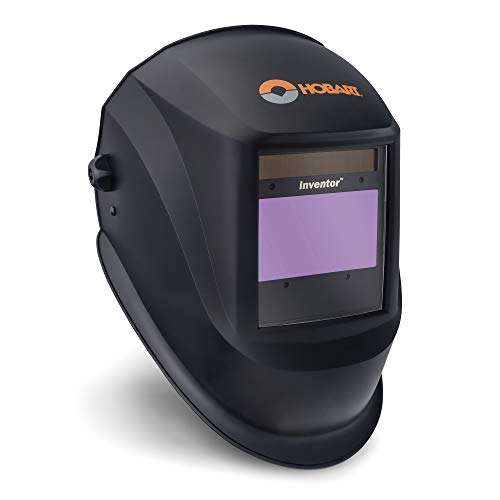
The Inventor 770890 is the mid-range benchmark for home shops and farm repair work. Hobart builds it around a PureColor lens with a widescreen 9.3 square inch viewing field measuring 3.94 by 2.36 inches (100 x 60 mm). Four independent arc sensors feed the filter, and the lens switches in 1/25,000 of a second.
Instead of menus, the Inventor uses analog knobs for shade, sensitivity and delay, which many welders prefer because gloved hands can work them by feel. The darkened state adjusts from shade 9 to 13, the light state is shade 3, and a grind mode holds the lens light for surface prep. At 19.7 ounces (560 g) it is the lightest helmet in this guide, which counts during overhead work. Hobart publishes a two year warranty for the Inventor series. The trade-off against the premium picks is the narrower shade range: there is no shade 5 to 8 band for cutting, and no published optical class figure. For MIG, flux core and stick work in a home shop, the specification covers the job well.
Specs
- Viewing area: 3.94 x 2.36 in (100 x 60 mm), 9.3 sq in
- Lens technology: PureColor Lens Technology
- Shade range: variable 9-13, light state shade 3
- Switching speed: 1/25,000 of a second
- Arc sensors: 4
- Operating modes: weld and grind
- Controls: analog knobs for shade, sensitivity and delay
- Weight: 19.7 oz (560 g)
- Warranty: 2 years
- Part number: 770890
4. YESWELDER LYG-M800H
The LYG-M800H is built around one of the widest windows in the mid-range tier: 3.93 by 3.66 inches (100 x 93 mm), nearly square, which gives a tall view of the joint and the surrounding work. The lens carries a 1/1/1/1 optical rating with true color output, plus a blue light blocking outer lens. Four arc sensors trigger a switching speed of 1/30,000 of a second, the fastest figure in this guide.
The shade range is broad, running from a light state of DIN 3 through dark bands of 5-9 and 9-13, so the same hood covers grinding, cutting and welding across TIG, MIG and stick processes. Power comes from a solar cell backed by a lithium battery, and YESWELDER publishes an average battery life of 3,000 hours. The shell is PP plastic, the package dimensions are 8.5 by 7.8 by 12.8 inches, and the box includes a storage bag, a spare lithium battery and three replacement cover lenses. At 2.2 pounds it is the heaviest helmet here, so it suits bench and shop work better than long overhead sessions.
Specs
- Viewing area: 3.93 x 3.66 in (100 x 93 mm)
- Optical clarity: 1/1/1/1, true color
- Shade range: 3/5-9/9-13
- Arc sensors: 4
- Switching speed: 1/30,000 of a second
- Power source: solar cell with lithium battery
- Average battery life: 3,000 hours
- Item weight: 2.2 lb
- Product dimensions: 8.5 x 7.8 x 12.8 in
- Material: PP
- Included: storage bag, spare lithium battery, 3 replacement lenses
- Part number: LY800H
5. Antra AH7-220-0000
The AH7-220-0000 covers the budget tier for occasional welding: trailer repairs, gate hinges, exhaust patches and similar jobs that come up a few times a year. Its auto-darkening filter reacts in 1/25,000 of a second, with a light state of DIN 4 and a variable dark state from DIN 9 to 13. Permanent UV and IR protection holds at shade DIN 13 even when the filter is off, which is the baseline safety figure to look for at any tier.
Power comes from a solar cell with two replaceable CR2032 batteries, so the helmet can sit in a drawer between jobs and still be ready. Antra includes six spare outer lens covers plus one fitted cover, which stretches the time before you need consumables. The limits show in the TIG rating: the sensors are rated for DC TIG above 5 amps, so low amperage TIG work belongs to the helmets higher up this list, and Antra does not publish a viewing area figure for this model. For MIG and stick work on a budget, the published numbers do the job.
Specs
- Model: AH7-220-0000
- Light state: shade DIN 4
- Dark state: variable shade DIN 9-13
- Switching speed: 1/25,000 of a second
- UV/IR protection: permanent shade DIN 13
- DC TIG rating: above 5 amps
- Power source: solar cell with 2 replaceable CR2032 batteries
- Included: 6 spare outer lens covers plus 1 fitted cover
- UPC: 874392007578
Frequently Asked Questions
What shade should a welding helmet be set to for MIG welding?
Published shade guides from helmet makers pair most MIG work with shades 10 to 12, moving darker as amperage climbs. A variable 9-13 helmet covers that band with room on both sides, which is why every model in this guide includes it.
How many arc sensors does a good welding helmet need?
Two sensors are enough for flat bench work where nothing blocks the view of the arc. Four sensors are the safer choice for out-of-position, pipe or cluttered fabrication work, because the lens still triggers when a part or fixture hides one sensor from the arc.
What does a 1/1/1/1 optical clarity rating mean?
It is the top EN 379 grade in four categories: optical clarity, light diffusion, shade consistency across the lens and consistency at viewing angles. A 1/1/1/1 lens gives the clearest, most even view of the puddle, while a 1/1/1/2 lens gives up a little performance at steep angles.
Can one helmet cover TIG, MIG and stick welding?
Yes, provided the shade range and the low amperage rating fit all three. Look for a variable range that reaches shade 13 for stick, and a TIG rating near 2 amps so faint TIG arcs trigger the lens reliably. The Lincoln VIKING 3350 and the ESAB Sentinel A50 meet both marks on their published figures.
Conclusion
The Lincoln Electric VIKING 3350 is the pick for welders who want the clearest published optics, the largest window and a 2 amp TIG floor in one premium helmet. The ESAB Sentinel A50 matches it on process range and adds digital memory presets for crews that switch jobs often. In the mid-range, the Hobart Inventor 770890 keeps controls simple and weight low, while the YESWELDER LYG-M800H trades some weight for a taller window and the fastest switching speed here. The Antra AH7-220-0000 rounds out the list as a budget helmet for MIG and stick work around the home shop. Compare the viewing area, shade range and TIG rating against the work you do most, and any of the five will protect your eyes while you do it.