Key takeaways
- Five hand planes for woodworking compared: No. 4 smoothing planes and low-angle block planes, with verified specs, setup tips, and safe handling advice.
- Top Pick: Stanley Sweetheart No. 4 Smoothing Plane (12-136)
- Runner-up: Spear & Jackson CSP4 No. 4 Smoothing Plane
- Also consider: Jorgensen No. 60-1/2 Low Angle Block Plane
A good hand plane does work that sandpaper and power tools handle poorly: it flattens a board without rounding its edges, takes whisper-thin shavings off figured grain, and trims end grain cleanly instead of tearing it. This guide compares five planes across the two formats most benches need — three No. 4 smoothing planes for general bench work and two low-angle block planes for trimming and end grain — with verified specifications for each.
One warning applies to all five: a plane iron is razor sharp, and it stays useful only if it is handled and stored properly. Keep both hands behind the cutting edge while you work, store every plane with its blade covered or retracted, and sharpen only as the maker directs. Those habits reduce risk, but no tool is risk-free, so work at a pace your skill level supports.
As an Amazon Associate, we earn from qualifying purchases.
Quick answer
For most benches, begin with a No. 4 smoothing plane: the Stanley Sweetheart No. 4 leads this list for its one-piece base and thick A2 iron. Add a low-angle block plane such as the Jorgensen No. 60-1/2 or the WoodRiver block plane for end grain and trimming. Spear & Jackson and Amazon Basics offer simpler No. 4 options.
Stanley Sweetheart No. 4 Smoothing Plane (12-136)
The Stanley Sweetheart No. 4 is the reference point for this group: a full-size smoothing plane built around a one-piece base and frog, which keeps the blade seated firmly so the cut stays even from pass to pass. Its iron is an extra-thick 1/8-inch A2 steel blade, and the Norris-type adjuster adds a lateral locking feature, so once depth and alignment are set they stay put while you work. An adjustable throat plate lets you close the mouth down for figured or reversing grain and open it up for heavier stock removal. The listing materials are cherry wood, cast iron and iron, with a cast iron base, and the plane is fully manual — no power source beyond your own arms. For final smoothing of panels, table tops and furniture parts, this is the most complete package of the five. Expect to hone the iron before first use, following the maker’s directions.
| Brand | Product | ASIN | Key specs |
|---|---|---|---|
| Stanley | STANLEY Hand Planer, No.4, Smoothing (12-136) | B002B56CUO | One-piece base and frog; extra-thick 1/8-inch A2 steel blade; Norris-type adjuster with lateral locking feature; adjustable throat plate; cast iron base; cherry wood, cast iron and iron materials; manual power source; UPC 076174121360 |

Jorgensen No. 60-1/2 Low Angle Block Plane

The Jorgensen No. 60-1/2 is the smaller, one-handed option in this guide: a 6-1/4-inch low-angle block plane with an O1 tool steel blade and a ductile iron body. A zinc alloy lever cap and stainless steel fittings round out the build, and at 1.5 pounds it is light enough to keep in an apron pocket or toolbox tray for trimming work. Both the mouth opening and the cutting depth adjust, which matters because end grain, edge chamfers and flush trimming each ask for a slightly different setup. Low-angle block planes earn their keep on end grain and small parts where a full bench plane feels clumsy, and this one covers that role without giving up adjustability. Keep the blade retracted or covered in the toolbox, as with any plane iron.
| Brand | Product | ASIN | Key specs |
|---|---|---|---|
| Jorgensen | Jorgensen No. 60-1/2 Low Angle Block Plane | B0BVZJLNK6 | 6-1/4 inch low angle block plane; O1 tool steel blade; ductile iron body; zinc alloy lever cap; stainless steel parts; adjustable mouth; adjustable cutting depth; item weight 1.5 pounds; orange; manual power source |
WoodRiver Low Angle Block Plane with Adjustable Mouth
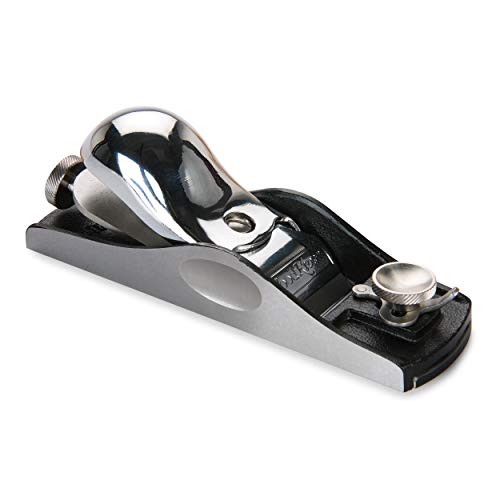
The WoodRiver low-angle block plane (model 151125W) takes a slightly larger approach to the same job. Its blade beds at a 12-degree angle, and the high carbon tool blade itself is ground at a 25-degree angle, 1-5/8 inches wide and 0.125 inches thick — a bevel-up arrangement that lets you change the effective cutting angle by honing a steeper micro-bevel. The body measures 2 inches wide by 7 inches long, and the knuckle-style lever cap is shaped to sit in the palm for controlled one-handed strokes. An adjustable mouth lets you close things down for difficult grain or open up for thicker shavings. If you prefer a heftier block plane with a palm-filling cap over a smaller pocket-sized tool, the WoodRiver is the pick here. Sharpen and adjust it as the maker directs before judging the cut.
| Brand | Product | ASIN | Key specs |
|---|---|---|---|
| WoodRiver | WoodRiver Low Angle Block Plane with Adjustable Mouth | B003VR65M6 | Model 151125W; 12-degree bed angle; high carbon tool blade with 25-degree blade angle, 1-5/8 inches wide by 0.125 inches thick; body 2 inches wide by 7 inches long; knuckle style lever cap; adjustable mouth; UPC 844788010611 |
Spear & Jackson CSP4 No. 4 Smoothing Plane
The Spear & Jackson CSP4 is a traditional No. 4 smoothing plane from a long-running British tool brand. The body and base are cast iron, the blade is 2-inch high carbon steel, and depth is set with a brass adjusting screw; the base and faces are precision milled, which is what you want to see on a plane expected to take fine, even shavings. At 1.8 kg it has the mass typical of the No. 4 format, and its footprint — 24.8 cm long, 6.3 cm wide and 4.2 cm high — matches the classic smoothing-plane pattern. It is the straightforward choice for a conventional bench plane without extra features to manage. Set the iron back or store the plane on its side between sessions so the edge never rests on the bench top.
| Brand | Product | ASIN | Key specs |
|---|---|---|---|
| Spear & Jackson | Spear & Jackson CSP4 No. 4 Smoothing Plane | B07KCTL39C | Model CSP4; cast iron body and base; 2-inch high carbon steel blade; brass adjusting screw; precision-milled base and faces; dimensions 24.8 x 6.3 x 4.2 cm; item weight 1.8 kg; hand powered |
Amazon Basics No. 4 Precision Smoothing Bench Plane
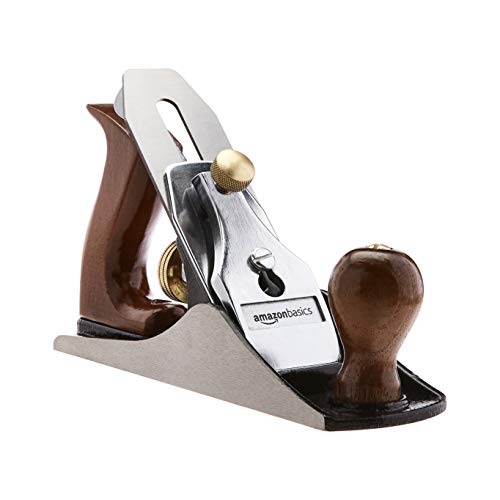
The Amazon Basics No. 4 (model DS-WPAMZ002) is the simplest route into bench planes in this group: a cast iron body and base, a 2-inch blade and wooden handles, in the Precision Smoothing variant of the No. 4 format. It measures 10 inches long, 2.6 inches wide and 5.5 inches high, and the blade is included in the box. It is the standard bench-plane layout for smoothing boards, doors and furniture parts, at an entry point to the category. Note that this pick is specifically the DS-WPAMZ002 Precision variant with wooden handles; a separate non-Precision variant exists under a different model, so check the model code at checkout. Like every plane here, it will cut best after a careful hone and setup following the maker’s directions.
| Brand | Product | ASIN | Key specs |
|---|---|---|---|
| Amazon Basics | Amazon Basics No. 4 Precision Smoothing Bench Plane | B07V81CNJN | Model DS-WPAMZ002; cast iron body and base; 2-inch blade; wooden handles; dimensions 10 x 2.6 x 5.5 inches; blade included; UPC 672352801613 |
How to Choose
Begin with format. A No. 4 bench plane is the general-purpose smoother: long enough to flatten modest boards, short enough to follow gentle curves, and the right tool for final surface work on furniture parts. A low-angle block plane is the trimmer: it rides in one hand, excels on end grain, chamfers and small fittings, and complements a bench plane rather than replacing it. Many woodworkers end up with one of each.
Next, look at the blade. Thicker irons, like the Stanley’s 1/8-inch A2 blade, tend to hold a setup well, while O1 and high carbon steels are quick to hone. Whatever the steel, budget for sharpening: a plane is only as good as its edge, so a stone or honing guide belongs in the same purchase plan. Adjustability matters too — a movable mouth and a lateral adjuster make fine work far easier to dial in. Finally, plan storage: a blade guard, a retracting habit, or a till slot keeps that razor edge away from fingers between sessions.
Who Should Skip
Skip this category if your workflow is entirely powered — a planer and jointer already surface your stock and you never fit parts by hand. Skip it if you only do rough framing or deck work, where a smoothing plane has nothing to smooth. Skip it, for now, if you are unwilling to learn basic sharpening: every plane here needs a honed edge and a short setup before it cuts well, and no model in this guide removes that step. If your projects call for a long jointer plane or a small detail plane, look at those sizes separately rather than forcing a No. 4 or a block plane into the wrong job.
FAQ
What is the difference between a bench plane and a block plane?
A bench plane, like the three No. 4 models here, is a two-handed tool with the blade bedded bevel-down, made for flattening and smoothing board faces. A block plane is a smaller one-handed tool, usually low-angle and bevel-up, made for trimming, chamfers and end grain. Most benches use both: the bench plane prepares the surface, the block plane fits the parts.
How often should a plane iron be sharpened?
Sharpen when the plane stops taking clean shavings, begins tearing grain, or needs noticeably more push — the exact interval depends on the wood and the steel. Follow the maker’s directions for angle and technique, keep hands behind the cutting edge while honing, and re-cover or retract the blade as soon as you finish. A few minutes of honing beats forcing a dull edge.
How should a hand plane be stored between uses?
Store it with the blade retracted or covered so the edge cannot contact the shelf, the bench, or your fingers. Many woodworkers rest a bench plane on its side for the same reason. Keep planes dry to protect the cast iron, and never toss a block plane loose into a toolbox where the exposed edge can strike other tools — or the hand reaching in for them.
Do these planes arrive ready to use out of the box?
Expect to do setup first. New planes typically need the iron honed, the cap iron and frog checked, and the mouth and depth set for your work, all following the maker’s directions. That session is normal for the category, and it is when you learn how your plane adjusts.
Final Verdict
For a single first purchase, the Stanley Sweetheart No. 4 is the strongest all-round bench plane here, with the Jorgensen No. 60-1/2 as its natural block-plane partner. The WoodRiver block plane suits hands that prefer a larger, palm-filling tool, the Spear & Jackson CSP4 keeps the traditional No. 4 pattern, and the Amazon Basics No. 4 is the entry point. Whichever you choose, hone it, set it up as the maker directs, and store that sharp edge covered.