Key takeaways
- Five digital angle gauges for woodworking compared: magnetic cube gauges and dual-range levels with accuracy, range, battery and zero-function notes.
A table saw’s built-in angle scale is a rough guide at best. A fraction of a degree of blade tilt that goes unnoticed on the scale shows up later as a gap in a miter or a box corner that will not close. A digital angle gauge solves this by measuring the blade itself: zero it on the saw table, stick its magnetic base to the blade, and read the actual angle as you tilt. The same small cube also checks miter saw fences, jointer fences and drill press tables.
This guide compares five digital angle gauges suited to woodworking, from compact magnetic cubes to a dual-range level. They differ in range, stated accuracy, resolution, battery type and display behavior. One caution applies to every pick: a gauge is a measuring aid, not a guarantee. Set the angle with the gauge, then verify it — saw unplugged, fence locked, test cut in scrap — before any good stock goes near the blade.
As an Amazon Associate, we earn from qualifying purchases.
Quick answer
For most woodworkers, a small magnetic cube gauge with 0.1 degree resolution and a zero function covers blade and miter setups. The Wixey WR300 Type 2 is the workshop staple, the Klein Tools 935DAG adds dual ranges and a tougher rating, and the iGaging AngleCube suits bevel work. Whichever you choose, confirm every setting with a test cut in scrap before cutting good stock.
Wixey WR300 Type 2 Digital Angle Gauge with Backlight

The WR300 Type 2 is the gauge many woodworkers picture when they think of a digital angle finder: a small cube, a backlit display, and magnets hidden in the base that hold it firmly to a saw blade. Its ±180° range covers everything from a square crosscut setup to full bevel tilts, and the 0.1° resolution matches the finest adjustment most saw trunnions can hold. The backlight matters more than it sounds, because blades are read in shadowed workshops.
The feature that defines the Type 2 is its ZERO function: set it on the saw table, press zero, then move it to the blade and the display reads the blade angle relative to the table, which is the number that actually matters. Stated accuracy is ±0.2° with ±0.1° repeatability. It runs on a single AAA battery with auto shut-off. Make sure the listing you order is the Type 2 with backlight; this pick is that AAA-powered version specifically.
| Brand | Product | ASIN | Key specs |
|---|---|---|---|
| Wixey | WR300 Type 2 Digital Angle Gauge with Backlight | B00T6YZ0K6 | Range ±180°; resolution 0.1°; accuracy ±0.2°; repeatability ±0.1°; 1x AAA battery; backlight; auto shut-off; magnets in base; 2.3 x 2.3 x 1.1 in |
GemRed 82412 Digital Angle Gauge (Green Backlight)

The GemRed 82412 takes the same cube format and adds a green-backlit LCD that stays readable at glancing angles. Its measuring range is 4×90°, which suits blade and fence work set quadrant by quadrant. Stated accuracy is ±0.2° with 0.1° resolution, and it offers absolute and relative modes, so it can read against true level or zero against a reference surface such as a saw table.
Magnets sit in the bottom face only, so this gauge is happiest sitting flat on a machine table or stuck to the flat of a blade. It weighs 70 g, runs on one included AAA battery, and its MEMS sensor shows an ERROR warning if the gauge is tilted diagonally more than 30°, telling you the reading cannot be trusted then. This pick is the basic 82412 with green backlight and degree-only display, not another variant sold under the same brand family.
| Brand | Product | ASIN | Key specs |
|---|---|---|---|
| GemRed | 82412 Digital Angle Gauge (Green Backlight) | B00WQLHG2G | Accuracy ±0.2°; resolution 0.1°; measuring range 4×90°; 1x AAA battery included; net weight 70 g; magnets in base; LCD with green backlight; ERROR warning when tilted diagonally over 30° |
iGaging AngleCube Digital Level + Bevel Gauge 2 in 1
The original AngleCube is the bevel specialist of this group. Its 0.05° resolution is the finest here, which suits woodworkers dialing in compound cuts where a tenth of a degree shows in the finished joint. Stated accuracy is ±0.2° and repeatability is 0.1°. Magnets on three sides of its precision-machined anodized aluminum body let it grip blades, fences and machine tables from several orientations.
It offers a ZERO function for relative bevel readings, an absolute level mode, and a HOLD function that freezes a reading taken where you cannot see the display. Power comes from a standard 9V battery, with shut-off after three to five idle minutes. This pick is specifically the original 9V AngleCube, so check that the listing describes that version, because the AngleCube name is also used on a newer rechargeable model that is a different product.
| Brand | Product | ASIN | Key specs |
|---|---|---|---|
| iGaging | AngleCube Digital Level + Bevel Gauge 2 in 1 (original) | B002LL0BIC | Accuracy ±0.2°; resolution 0.05°; repeatability 0.1°; standard 9V battery; auto power-off in 3 to 5 minutes; HOLD function; anodized aluminum body; magnets on 3 sides |
Klein Tools 935DAG Digital Electronic Level and Angle Gauge
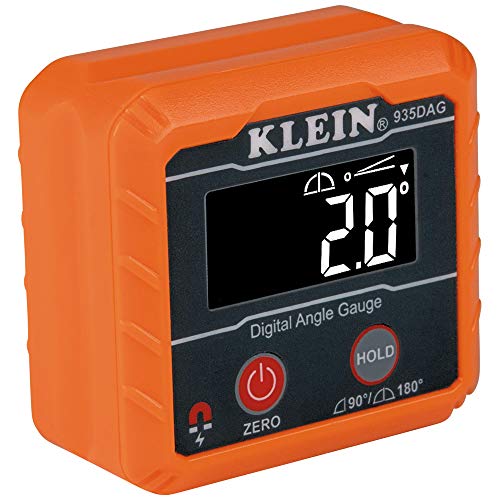
The Klein 935DAG is the most fully featured gauge here, and the only pick that also works as a small level. It measures across two ranges, 0–90° and 0–180°, and its stated accuracy tightens to ±0.1° near level, plumb and flat (0–1°, 89–91° and 179–180°), holding ±0.2° elsewhere, with 0.1° display precision. A permanent rare-earth magnet base and V-grooves around its entire perimeter let it sit securely on blades, fences and even round stock.
The housing is rated IP42 and drop-tested to 6.6 ft. It runs on two included AAA batteries, comes with a soft carrying case, and at 3.5 oz is light enough not to drag on a blade. Order the base 935DAG exactly as named; similar-looking variants with different model names are different products.
| Brand | Product | ASIN | Key specs |
|---|---|---|---|
| Klein Tools | 935DAG Digital Electronic Level and Angle Gauge | B07ZWW3BW5 | Ranges 0–90° and 0–180°; accuracy ±0.1° near level, plumb and flat, ±0.2° elsewhere; display precision 0.1°; rare-earth magnet base; V-grooves around entire perimeter; IP42; drop protection 6.6 ft; 2x AAA batteries included; 2.36 x 2.2 x 1.2 in; 3.5 oz |
Neoteck NTK034 Digital Angle Finder
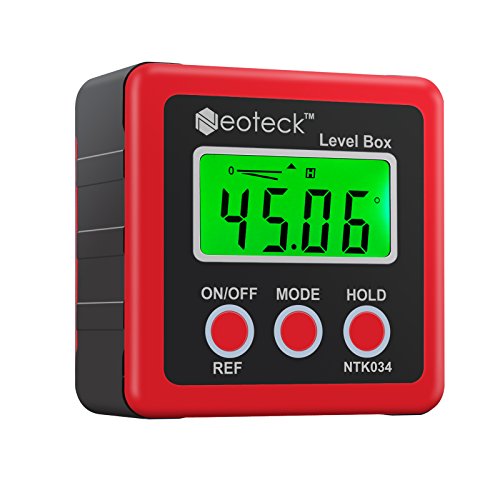
The Neoteck NTK034 stands out for its display: a backlit LCD with 0.01° resolution and a flip function that keeps the digits upright when the gauge is used upside down under a blade or table. Its range is 4×90° with stated accuracy of ±0.2°, and it switches between absolute and relative modes. Unusually for this class, it also converts readings between degrees, percent slope, in/ft and mm/m, which helps when a plan specifies slope rather than angle.
The body is rated IP54 against dust and water splashes, and it powers off after three minutes. It runs on two included LR03 AAA batteries and measures 2.28 x 2.28 x 1.22 in at 4.59 oz, with an 18-month warranty. This pick is the AAA-powered box-gauge version with backlight; the same brand also sells rechargeable and protractor-style models that are different tools with different specifications.
| Brand | Product | ASIN | Key specs |
|---|---|---|---|
| Neoteck | NTK034 Digital Angle Finder | B06XYGHWTM | Range 4×90°; accuracy ±0.2°; resolution 0.01°; 2x LR03 AAA batteries included; IP54 dust and water resistant; backlight LCD with flip display; converts degrees, percent slope, in/ft and mm/m; 2.28 x 2.28 x 1.22 in; 4.59 oz; 18-month warranty |
How to Choose
Start with range. A 4×90° gauge covers most blade and fence setups, while a ±180° or dual-range model adds flexibility for level work. Next, separate resolution from accuracy: resolution is the smallest step the display can show, while accuracy is how close the reading sits to the true angle. A fine display cannot rescue a loose sensor, so weigh stated accuracy first.
A zero, or relative, function is close to essential for saw work, because the angle that matters is blade-to-table, not blade-to-gravity. A strong magnetic base matters just as much; the gauge must stay put while you reach for the tilt wheel. Check battery type before ordering, and keep spares for any shop instrument stored dry and in their packaging. Button-cell batteries used by some shop tools should be stored out of children’s reach, exactly as the maker’s directions say.
Finally, build verification into your routine. A gauge is a measuring aid only: unplug the saw, set the angle, lock the trunnion, then make a test cut in scrap and check the cut piece before committing good stock.
Who Should Skip
Skip this category if you only square a fence once in a while and already own a good combination square you trust; for occasional setups, careful square work may be all you need. Skip these consumer gauges if your work requires certified, traceable calibration for inspection or client sign-off, since none is a metrology instrument. And skip the box format if your main need is laying out miter angles on trim in place; a protractor-style gauge fits that work better.
FAQ
How accurate does a digital angle gauge need to be for woodworking?
For most furniture and cabinet work, a stated accuracy of ±0.2° is workable, because smaller errors are hard to see in a joint and hard to hold on typical saw adjustments. What matters more is repeatability and routine: confirm the setting with a test cut in scrap before cutting real parts.
How do I set a table saw blade with a digital angle gauge?
Unplug the saw first. Place the gauge on the clean saw table and zero it, then set its magnetic base flat against the blade plate, avoiding the teeth. Tilt the blade until the display shows your target angle, lock the tilt mechanism, and remove the gauge. Then make a test cut in scrap and check the cut angle before using good stock.
What is the difference between absolute and relative mode?
Absolute mode reads against true level and plumb, useful for checking machine tables and fences. Relative mode lets you zero the gauge on any reference surface, such as a saw table, then read a second surface, such as the blade, against that reference. Blade setup is almost always relative work.
How should I store spare batteries for shop gauges?
Keep spares in their original packaging in a dry drawer so terminals cannot touch loose metal. Button-cell batteries in particular must be stored out of children’s reach, following the maker’s directions, because they are a serious ingestion hazard if swallowed. Recycle dead cells rather than binning them with household waste.
Final Verdict
For a single do-everything pick, the Wixey WR300 Type 2 covers the core job — blade, fence and bevel checks — with a simple zero function and backlit display. The Klein Tools 935DAG is the step up for woodworkers who also want level duty and tighter stated accuracy near level and plumb. Bevel-focused work favors the iGaging AngleCube and its finer resolution, the GemRed 82412 keeps things compact and simple, and the Neoteck NTK034 earns its place with its flip display and unit conversions. Whichever gauge you choose, treat it as a measuring aid: verify every important setting with the saw unplugged and a test cut in scrap.