Key takeaways
- A rainy afternoon, a card table, and a half-finished picture of dinosaurs: that is how many kids discover that they enjoy puzzles.
A rainy afternoon, a card table, and a half-finished picture of dinosaurs: that is how many kids discover that they enjoy puzzles. The puzzle does not need to be fancy. It needs to match the child’s hands, patience, and interests so that finishing feels possible. A puzzle that is too hard ends up in the closet, and one that is too easy is finished in minutes and forgotten.
This guide looks at five jigsaw puzzles from well-known makers and explains how to pick the right difficulty. Only product names are used as facts, so the buying rules below focus on piece count, piece size, board thickness, and theme. Those four checks usually predict whether a puzzle becomes a favorite or a frustration. Think of the purchase as a series of steps, not a single decision, because children move up in difficulty faster than most parents expect.
Quick Picks
| Product | Best for | Worth knowing |
|---|---|---|
| Melissa & Doug Underwater Floor Puzzle 48 Pieces | Preschoolers who like big floor puzzles | Piece count of 48 is in the name |
| Melissa & Doug Dinosaur Floor Puzzle 48 Pieces | Dinosaur fans on the floor | Same piece count, different theme |
| Ravensburger Disney Frozen 100 Piece Jigsaw Puzzle | Early elementary children who like a movie theme | One hundred pieces is a step up in difficulty |
| Ravensburger Disney Princess 100 Piece Jigsaw Puzzle | Kids who like characters and a medium challenge | Also a 100-piece format |
| Mudpuppy World Map Puzzle 100 Pieces | Curious kids who enjoy geography | World map theme with 100 pieces |
How to Choose
Match piece count to age and experience
A common guide is 24 to 48 large pieces for ages three to four, 60 to 100 pieces for ages five to six, and 100 to 200 for ages seven to nine. If a child has never done a puzzle, start at the lower end and move up. A puzzle that is slightly easy builds confidence, which matters more than a perfect age match. Siblings sharing a puzzle can work at different levels, with the older child handling the edge and the younger one matching colors, so a middle count of 100 pieces sometimes works for a mixed-age pair.
Look at piece size and shape
Larger pieces are easier for small hands to pick up, and clear knobs and sockets make matching simpler. Floor puzzles use oversized pieces that can be laid on the rug, while table puzzles at 100 pieces or more use smaller pieces. Look for pieces that are cut cleanly without fuzzy edges, since rough cuts slow down young builders. Pieces that click firmly into place give a satisfying feel and prevent the puzzle from falling apart when you slide it onto a tray.
Check board thickness and durability
Thick cardboard or chunky board resists bending and chewing and survives repeated use, which suits younger kids and shared classrooms. Thinner puzzles feel lighter and are fine for older children who handle pieces carefully. A good rule of thumb is that thicker pieces last longer for kids under six. A sturdy storage box with a lid, or a resealable bag inside the box, also helps pieces survive a trip to a friend’s house or a classroom.
Choose a theme that holds attention
Picture quality and theme drive motivation. Animals, vehicles, favorite characters, and maps all work, and a puzzle with distinct color areas is easier than one with a single color across the image. An image on the box that matches the puzzle helps younger builders see where pieces fit. Glossy finishes can create glare under a bright lamp, so a matte surface is easier on the eyes during long sessions.
Our Picks Reviewed
Melissa & Doug Underwater Floor Puzzle 48 Pieces

Melissa & Doug Underwater Jumbo Floor Puzzle 48-Piece Ocean Animal Toy | 48 Wipe-Clean Pieces, 3x2 Feet, Ocean Animal Scene and Illustrated Guide, Floor Puzzle Play, Preschool Toys for Kids, Ages 3+


As an Amazon Associate we earn from qualifying purchases. Product prices and availability are accurate as of the date/time indicated.
The name tells you the maker, the underwater theme, and the 48-piece count. The floor puzzle format suggests oversized pieces made for little hands working on the rug.
- Pro: a floor puzzle encourages kids to spread out and work on a large scale, which suits preschoolers and builds fine motor skills.
- Pro: a 48-piece count is a manageable challenge for a young child who is moving beyond basic wooden puzzles.
- Con: a large floor puzzle needs a clear area, so it is harder to leave in progress on a busy day.
Skip it if your child is already comfortable with 100-piece puzzles or if you have no space for a large floor layout. Older children may find an ocean scene too easy and prefer a more detailed design. Lay the pieces face up in a shallow lid before you start, since sorting edges first turns a big floor puzzle into a series of small wins.
Melissa & Doug Dinosaur Floor Puzzle 48 Pieces

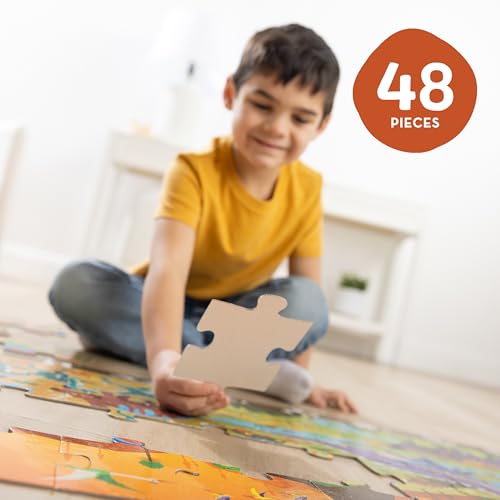
Melissa & Doug Land of Dinosaurs Jumbo Floor Puzzle 48-Piece Toy | 48 Wipe-Clean Pieces, Over 4 Feet Long, Search & Find Game, Educational Floor Puzzle Play, Learning Toys for Kids, Ages 6+



As an Amazon Associate we earn from qualifying purchases. Product prices and availability are accurate as of the date/time indicated.
This sibling product swaps the ocean for a dinosaur theme while keeping the 48-piece floor format. It is a good example of how a theme can match a child’s current obsession.
- Pro: dinosaurs are a reliably popular topic, which helps a child stick with the puzzle through the harder middle pieces.
- Pro: the same piece count makes it easy to build a small collection and trade between themes as interest changes.
- Con: owning two puzzles from the same line may feel repetitive if your child wants a completely different challenge.
Skip it if you already have the underwater puzzle and want a step up in difficulty, or if dinosaurs are not a hit at your house. Pick a theme that matches your child’s interest. Keep the box image where the child can see it, and let them pick the first few pieces so they feel ownership of the build.
Ravensburger Disney Frozen 100 Piece Jigsaw Puzzle

Ravensburger Disney Frozen 2 Puzzle - Magic of The Forest | Unique 100-Piece Jigsaw | Educational Toy for Kids Anti-Glare Surface | FSC Certified


As an Amazon Associate we earn from qualifying purchases. Product prices and availability are accurate as of the date/time indicated.
Ravensburger is a well-known puzzle maker, and this listing names a Disney Frozen theme with a 100-piece count. That count is a common next step after floor puzzles.
- Pro: a familiar movie theme motivates children who might otherwise lose interest at the 100-piece level.
- Pro: a one-hundred-piece format is a good bridge between preschool puzzles and larger family puzzles.
- Con: character art with many similar colors, such as snowy scenes, can be harder than it looks.
Skip it if your child is still working on 48-piece puzzles, or if you prefer non-licensed artwork. Parents wanting a quiet game alongside other toys might also look at kids robot toys for a different kind of challenge. Try sorting edges, then characters, then background, which is a simple three-step plan that makes a 100-piece puzzle feel manageable.
Ravensburger Disney Princess 100 Piece Jigsaw Puzzle

Ravensburger Disney Princesses - 100 Piece Jigsaw Puzzle for Kids | Unique Puzzle Pieces | Premium Quality | Ideal Educational Toy | Perfect


As an Amazon Associate we earn from qualifying purchases. Product prices and availability are accurate as of the date/time indicated.
This second Ravensburger option shares the 100-piece count and Disney branding but uses a Princess theme, which gives you another way to match a child’s tastes.
- Pro: colorful character artwork helps a child spot distinct regions, so sorting pieces by color becomes easier.
- Pro: a 100-piece count suits independent play for a child who can concentrate for twenty minutes or more.
- Con: licensed themes may feel dated as a child’s interests change, so the puzzle may sit unused later.
Skip it if your child is ready for more than 100 pieces, or if you want educational content rather than characters. Families already owning a Frozen puzzle may prefer a different subject. Let your child choose which part of the picture to start with, since a favorite character or color is often the easiest way into a longer puzzle.
Mudpuppy World Map Puzzle 100 Pieces

Mudpuppy Map of The World 100 Piece Puzzle – 100 Piece Jigsaw Puzzle with Continents Oceans Animals Landmarks and Educational Geography Illustrations for Children Ages 5 and Up


As an Amazon Associate we earn from qualifying purchases. Product prices and availability are accurate as of the date/time indicated.
Mudpuppy makes puzzles with an educational feel, and this listing combines a world map theme with a 100-piece count. It blends puzzle time with early geography.
- Pro: a map puzzle invites questions about countries and continents, which adds learning to the play.
- Pro: distinct regions and shapes help kids sort pieces, so the build has natural landmarks to start with.
- Con: a map can be abstract for younger children, so a parent may need to help at first.
Skip it if your child prefers cartoon characters or if you want a puzzle for ages four and under. Choose an animal or vehicle theme if a map does not hold interest. Keep an atlas or a globe nearby, because looking up a country while building is half the fun and makes the geography stick.
Which One Fits
Think about the child first and the puzzle second. A four-year-old with a short attention span does best with a bold, large-piece format, while a seven-year-old who loves facts may stick with a detailed map for an hour.
- Ages three to four, first big puzzles: the Melissa & Doug floor puzzles, which use a large format and a modest count.
- Kids moving up in difficulty: the Ravensburger Frozen or Princess 100-piece options.
- Curious kids who ask where things are: the Mudpuppy World Map, which pairs well with a globe or an atlas on the table.
- Screen-free time after a busy day: pair puzzles with a project such as kids baking sets for a rainy afternoon.
Common Mistakes
- Jumping to a high piece count too soon and ending with frustration, which can put a child off puzzles for months.
- Ignoring storage, so pieces get lost in a box with a weak lid or in a bag that tears open.
- Buying a theme the child does not care about, which kills interest quickly, even when the piece count is right.
- Letting the box image disappear or tossing the lid, which removes the best reference for young builders and makes the build harder.
- Working on a surface that is too small, so pieces slide to the floor and disappear under furniture.
FAQ
What piece count should I start with?
For beginners, start with 24 to 48 large pieces and increase gradually. Moving up when the child finishes confidently works better than guessing from age alone, and a puzzle at the lower end is never wasted.
Are floor puzzles better than table puzzles?
Floor puzzles use large pieces and suit toddlers and preschoolers. Table puzzles suit older children who can sit still longer.
How can I keep pieces from getting lost?
Use a sturdy box or a zip bag, and keep a puzzle mat for quick cleanup. Sorting edge pieces first also helps the build.
Do puzzles help development?
They support problem solving, hand-eye coordination, spatial reasoning, and patience, and they give kids a quiet activity that ends with a visible result. A timer or a kids clock for time management can add structure to a puzzle session.
When should I move to harder puzzles?
When your child completes the current one quickly and asks for more, try the next step up, such as 100 to 200 pieces. Keep an easier puzzle around for days when patience is low.